Flow laws
MILEVA carries published laboratory flow laws for the mantle and the crust as named presets (physics/flow_laws.jl). Each law is stored exactly as its paper prints it: prefactor and its units, exponents, activation energy and volume, the test geometry and the citation. Every number was checked against the original table where it could be read (13 October 2026); where only a secondary compilation could be read, the table below says so.
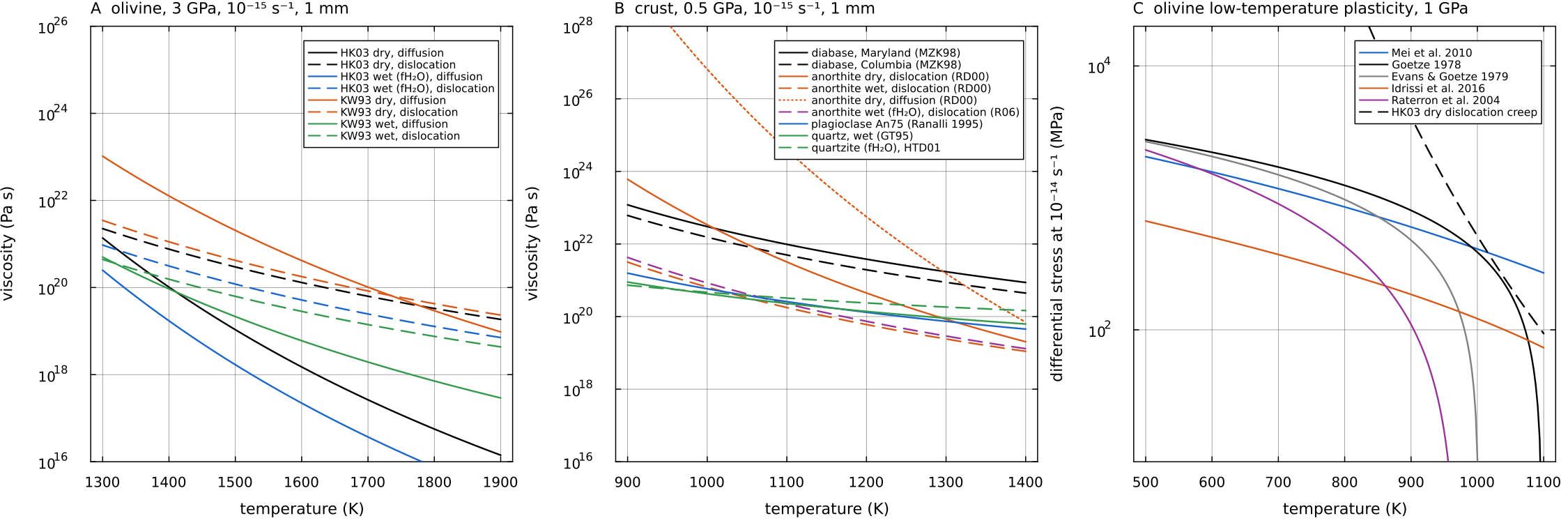
The presets evaluated with the code's own flowlaw_viscosity. (A) Olivine creep at 3 GPa, docs/scripts/fig_flow_laws.jl.
Physical background
How hot rock flows
Over geological time the mantle and the deep crust behave as an extremely viscous fluid, although they remain crystalline solids. They deform by solid-state creep, the slow and thermally activated motion of defects in the crystal lattice. Which defect carries the deformation depends on temperature, pressure, stress and grain size, and each choice gives a different relation between stress and strain rate. That relation, measured on rock samples in the laboratory and written as an equation, is a flow law (Frost & Ashby 1982; Karato 2008). Four mechanisms matter for convection models, and MILEVA has presets for all four.
Diffusion creep. Atoms diffuse, through the grain interiors or along the grain boundaries, from boundaries under compression to boundaries under tension, so each grain slowly changes shape. The strain rate is proportional to the stress (
, a Newtonian fluid) and falls steeply with grain size, as when diffusion through the lattice controls the rate and as when diffusion along grain boundaries does. The Hirth & Kohlstedt (2003) olivine laws use . Small grains and low stress favour it. Dislocation creep. Line defects in the lattice glide on slip planes and climb past obstacles by diffusion. More stress produces more mobile dislocations as well as pushing each one harder, so the strain rate rises as a power of the stress,
to for olivine, and does not depend on grain size. Large grains and high stress favour it, and because slip happens on particular crystal planes it aligns the grains, which is the origin of much of the seismic anisotropy of the upper mantle (Karato 2008). Grain-boundary sliding. Grains slide past one another, and the misfits this creates are relieved by dislocation motion. In the dislocation-accommodated form of Hirth & Kohlstedt (2003) it combines a dislocation-like stress exponent (
) with a weaker grain-size dependence ( ), and it matters near the boundary between the two mechanisms above. Peierls (low-temperature) plasticity. At low temperature and high stress the resistance of the lattice itself to dislocation glide, the Peierls barrier, controls the rate. The applied stress lowers that barrier, so the stress appears inside the exponential and the strain rate rises far more steeply with stress than any power law allows. It sets the strength of the cold lithospheric mantle at stresses of hundreds of megapascals (Kohlstedt et al. 1995; Mei et al. 2010).
All four are thermally activated. The factor
The mechanisms operate side by side in the same rock, each straining the material at its own rate. At a given stress their strain rates add, so the fastest mechanism dominates and the rock is as weak as its weakest mechanism allows. A deformation-mechanism map (Frost & Ashby 1982) draws, in stress-grain-size or stress-temperature space, the fields in which each mechanism wins. Karato & Wu (1993) concluded that the Earth's upper mantle lies close to the boundary between diffusion and dislocation creep, so that both have to be carried in a model and grain size decides between them.
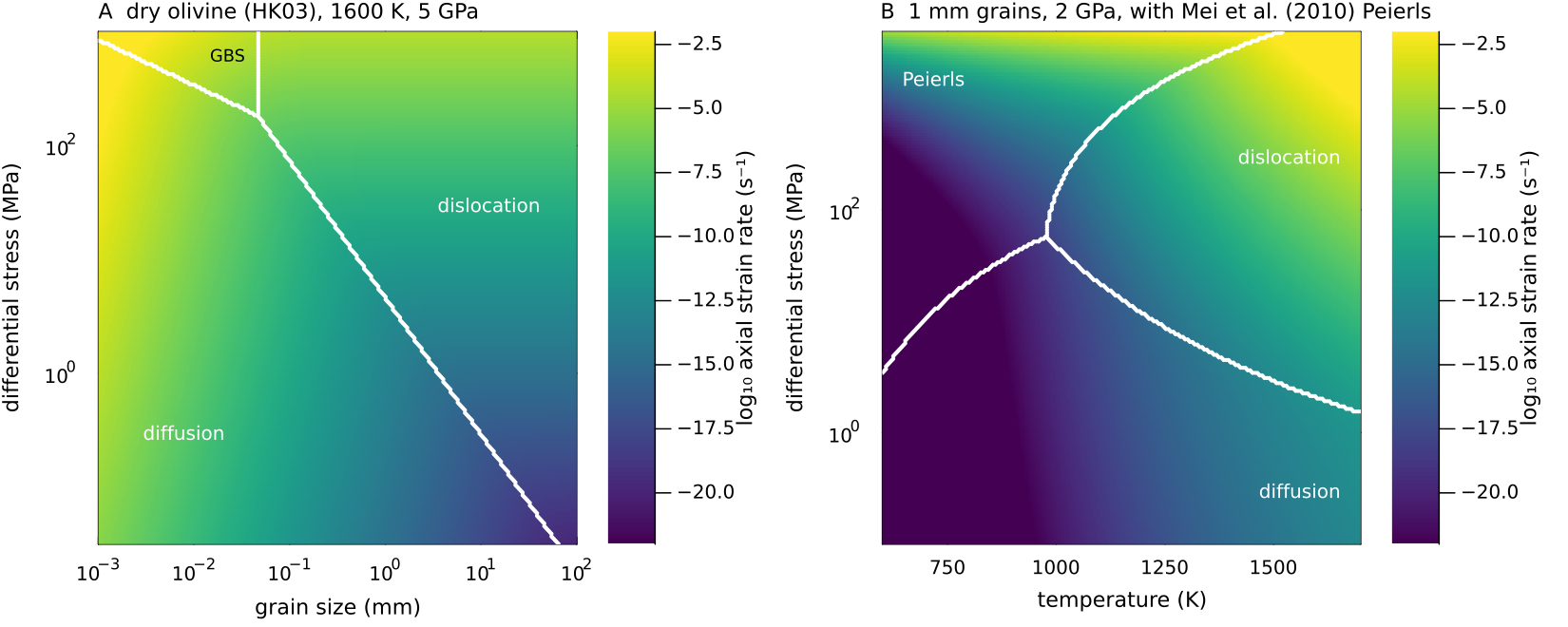
Deformation-mechanism maps drawn with flowlaw_strainrate for the Hirth & Kohlstedt (2003) dry olivine presets (diffusion, dislocation and grain-boundary sliding) and, on the right, the Mei et al. (2010) Peierls law. Colour: the total axial strain rate at each differential stress; white lines: where the fastest mechanism changes. Left: 1600 K and 5 GPa, where diffusion creep wins at small grains and low stress, dislocation creep at large grains, and sliding only in a corner of small grains and high stress. Right: 1 mm grains at 2 GPa, where Peierls plasticity takes over below about 1000 K, above a stress that falls from about 50 MPa at 1000 K to a few megapascals at 600 K. Script: docs/scripts/fig_flow_laws_sections.jl.
Why the flow law matters
The viscosity is the coefficient that turns buoyancy into flow in the Stokes equations (see Governing equations), so it sets the velocity of convection and, through the Rayleigh number, which is inversely proportional to it, the vigour of the whole calculation. Three properties of a flow law shape the dynamics.
Temperature dependence makes the cold top boundary layer orders of magnitude stiffer than the interior. When the viscosity contrast across it is large enough the layer stops taking part in the flow and becomes a stagnant lid, the regime of one-plate planets (Solomatov 1995).
Stress dependence (
) makes the rock shear thinning. At a fixed strain rate the viscosity varies as , so where the flow is fast the rock is weak, which concentrates deformation into narrow zones. Grain-size dependence couples the viscosity to the microstructure, which is why diffusion creep and grain-size evolution (Grain-size evolution) belong together.
Near the surface creep is not the whole story. The strength of the lithosphere at any depth is the smaller of its frictional strength, which grows with pressure, and its creep strength, which falls with temperature; plotted against depth this gives the familiar strength envelope (Kohlstedt et al. 1995; Bürgmann & Dresen 2008). In MILEVA the frictional part is the yield law of Rheology and the creep part is the flow laws of this page, with the Peierls law covering the cold, high-stress regime between them.
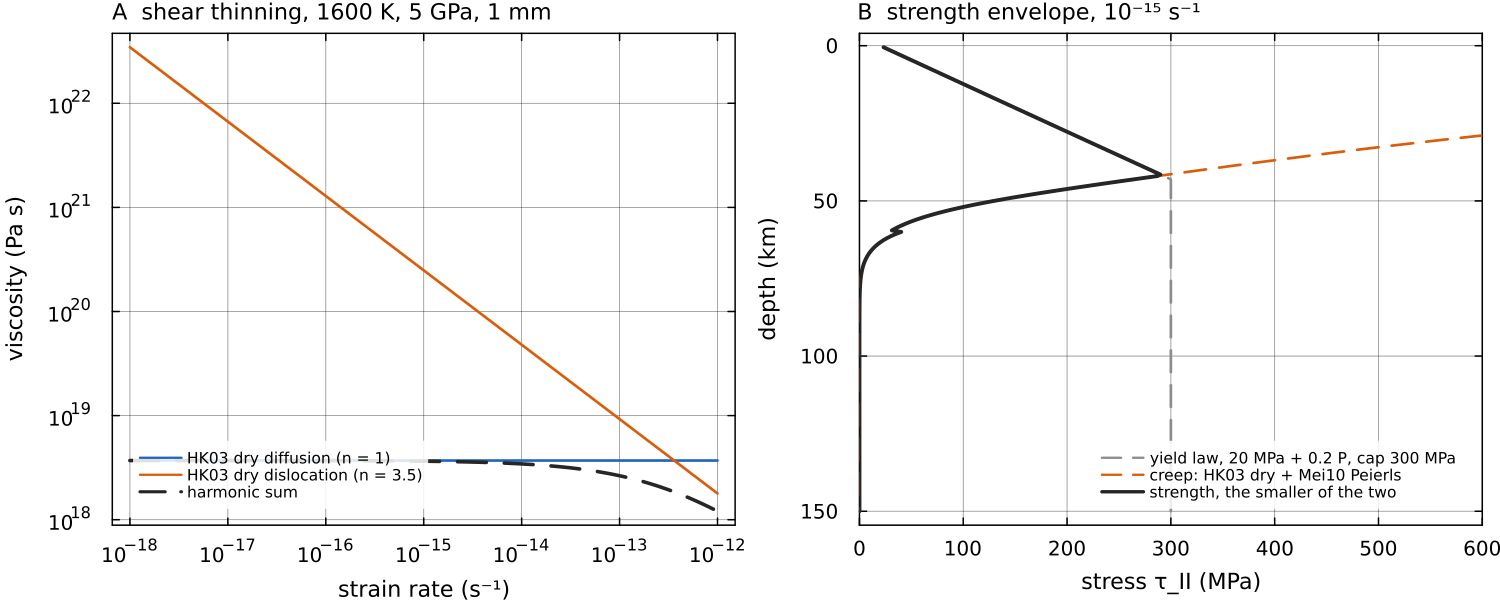
Left: shear thinning. flowlaw_viscosity for Hirth & Kohlstedt (2003) dry olivine at 1600 K, 5 GPa and 1 mm grains; dislocation creep weakens with strain rate and takes over from diffusion creep near composite_rheology evaluates only below 1100 K, hence the small step near 60 km. Script: docs/scripts/fig_flow_laws_sections.jl.
Scales, from the presets themselves
The sensitivities follow directly from the flow-law exponents. The table gives them for the Hirth & Kohlstedt (2003) dry olivine presets with 1 mm grains, evaluated with the formulas of the next section at a fixed strain-rate invariant of
| Change | Diffusion creep viscosity | Dislocation creep viscosity |
|---|---|---|
| lower by a factor 7.6 | lower by a factor 2.4 | |
| higher by a factor 6.1 | higher by a factor 3.6 | |
| strain rate ten times larger | unchanged | lower by a factor 5.2 |
| grain size ten times larger | higher by a factor 1000 | unchanged |
Dislocation creep looks less sensitive to temperature and pressure than diffusion creep in this table only because the viscosity is compared at a fixed strain rate. At fixed strain rate the Arrhenius factor enters the viscosity with the power
At 1600 K and 5 GPa these presets give
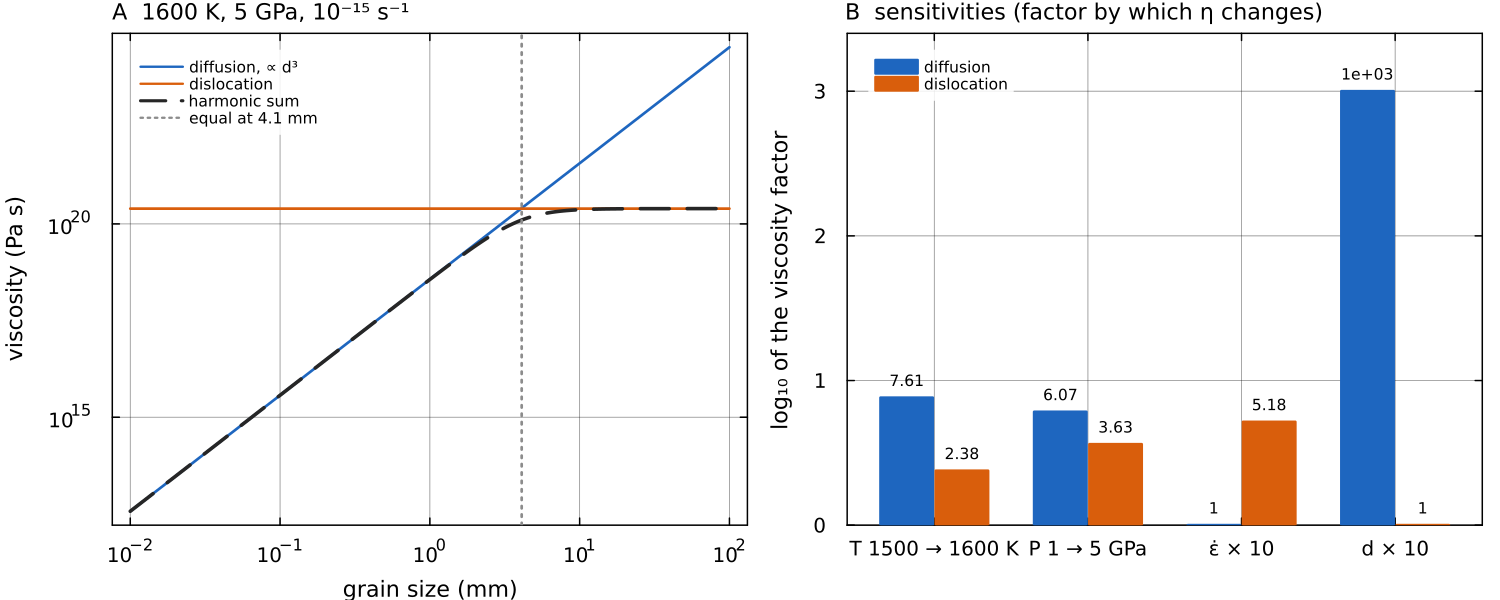
Left: the two Hirth & Kohlstedt (2003) dry olivine presets at 1600 K, 5 GPa and flowlaw_viscosity calls, on a logarithmic axis. Script: docs/scripts/fig_flow_laws_sections.jl.
Earth, Venus and Mars
Two conditions separate the planets for the purposes of this page. The Earth's upper mantle contains water dissolved in olivine as hydrogen defects, which weakens both creep mechanisms; the wet laws of Hirth & Kohlstedt (2003) describe that through the water fugacity
Mars sits at the other end. Its surface is cold, about 220 K, and its gravity, 3.7 m s⁻², is little more than a third of the Earth's, so the lithostatic pressure, and with it the frictional strength, grows more slowly with depth. Models of the Martian elastic lithosphere commonly take dry diabase for the crust over dry olivine for the mantle (Grott & Breuer 2008), the same pairing as for Venus, and the figure uses it here.
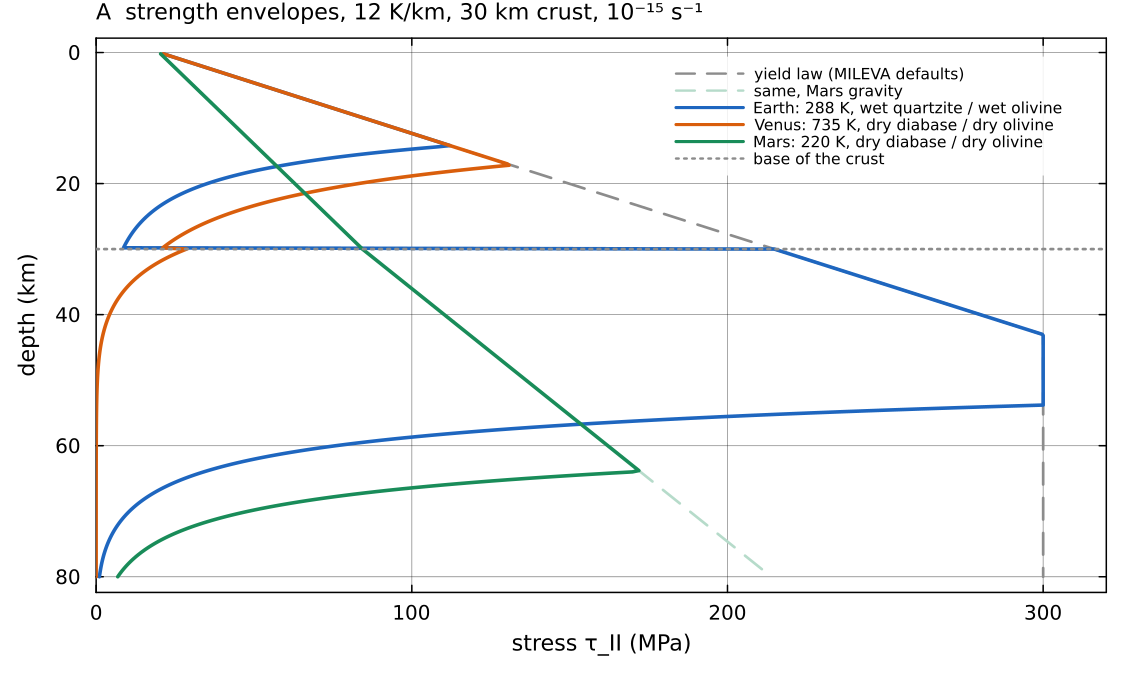
Strength envelopes at flowlaw_viscosity. Earth (blue): 288 K surface, wet quartzite (Hirth et al. 2001, docs/scripts/fig_flow_laws_sections.jl.
Using them in a run
The laws are used on the composite path (cfg.useCompositeRheology = true). Each field takes a key from the tables below; :none keeps the reference-viscosity creep laws of Rheology:
mat.flowlaw_diffusion         = :HK03_dry_olivine_diffusion
mat.flowlaw_dislocation       = :HK03_dry_olivine_dislocation
mat.flowlaw_grain_size        = 5e-3                 # m (default 1e-3), unless cfg.evolveGrainSize
mat.flowlaw_water             = 0.0                  # fH2O (MPa) or C_OH (H/10^6 Si)
mat.flowlaw_crust_dislocation = :MZK98_maryland_diabase   # where there is basalt
cfg.usePeierlsCreep = true                           # law: mat.flowlaw_peierls
The mantle laws replace
and in the harmonic sum. Below cfg.depth660kmthey, the grain-boundary sliding law and the Peierls law are all multiplied bycfg.eta660kmFactorwhencfg.use660kmJumpis on. Withcfg.useGBSand a dislocation preset selected, the grain-boundary sliding term becomes the Hirth & Kohlstedt (2003) dry law, on its T < 1250 °C or T > 1250 °C branch cell by cell.The crustal laws replace the basalt factor: where the basalt fraction is
, . The Peierls law (
mat.flowlaw_peierls, default:Mei10_olivine_peierls) joins the harmonic sum whereK. Depletion stiffening is a property of the mantle fraction of a cell only:
above already carries the full depletion factor , and the crustal law is never scaled by it. The cell's net stiffening is therefore , full in mantle and absent in pure crust. Without a crustal law the basalt factor mixes the same way, . Yielding, the viscosity bounds and the smoothing act on the result as before.
flow_law(:key) returns a preset, FLOW_LAWS holds them all, and flowlaw_viscosity(law, T, P, eII, d, W) evaluates one.
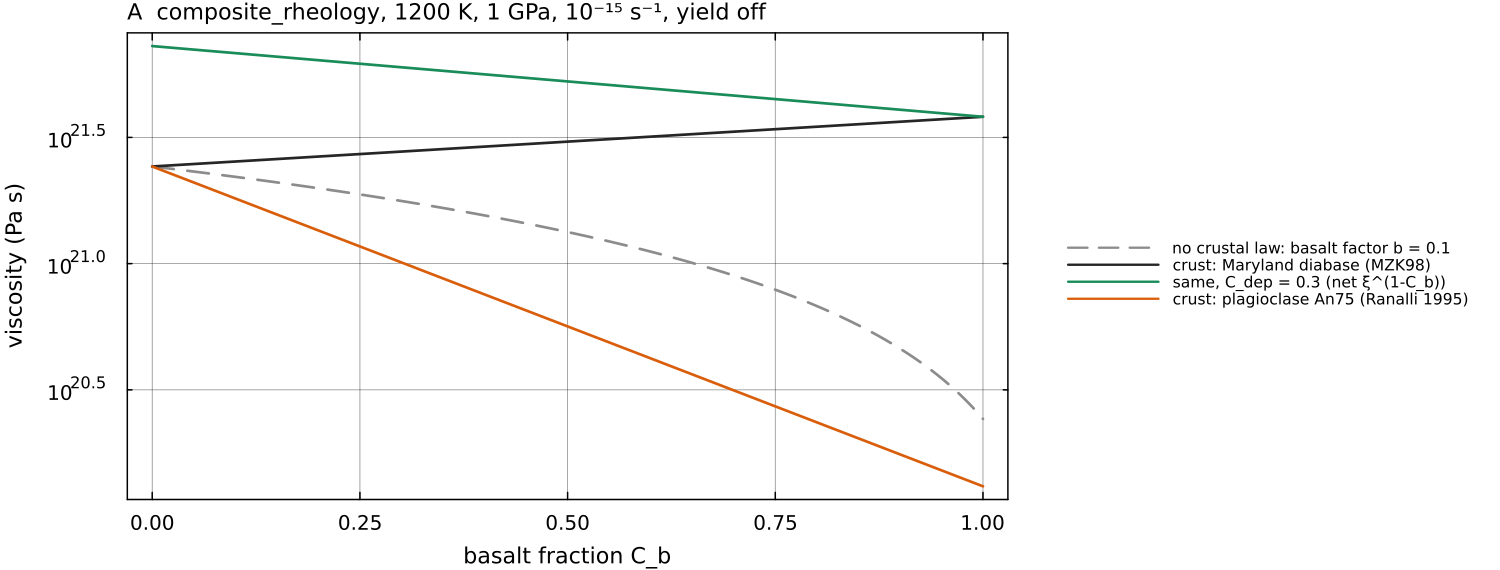
composite_rheology for a cell at 1200 K, 1 GPa and docs/scripts/fig_flow_laws_sections.jl.
From a laboratory law to a viscosity
A laboratory flow law says how fast a rock sample shortens under a given stress, while the flow solver needs the opposite, a viscosity at the strain rate the flow already has. MILEVA therefore takes each law exactly as published, converts the cell's strain rate into the strain rate of the laboratory test, and asks which stress the law needs to produce it. For the power laws that question has a closed-form answer; for the Peierls law, whose stress dependence sits inside an exponential, the code finds it by bisection. The stress divided by twice the strain rate is the viscosity of that mechanism, and the mechanisms are then added in parallel, the weakest one carrying most of the deformation.
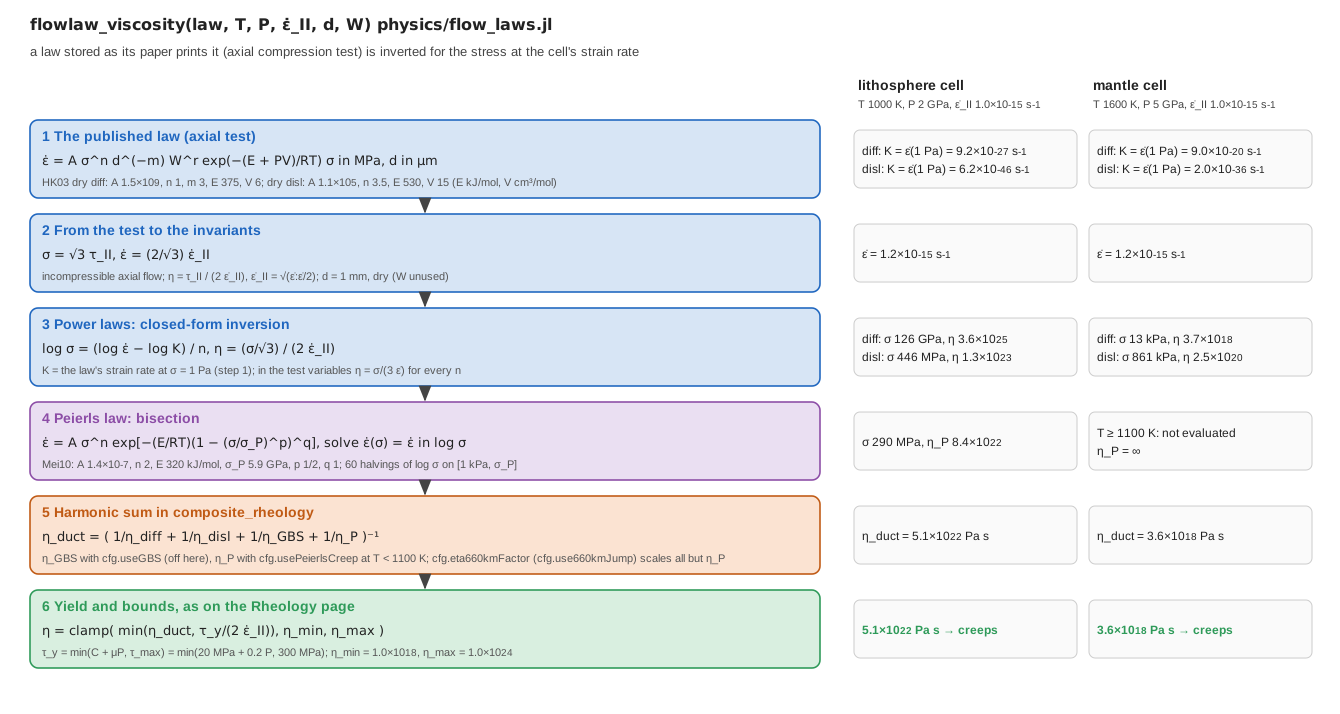
The steps for Hirth & Kohlstedt (2003) dry olivine diffusion and dislocation creep and the Mei et al. (2010) Peierls law (cfg.usePeierlsCreep = true), 1 mm grains, at a lithosphere cell (1000 K, 2 GPa, flowlaw_viscosity and composite_rheology. Script: docs/scripts/fig_flow_laws_pipeline.jl.
Laboratory laws relate the differential stress
where
so a law is turned into a viscosity by solving
The symbols
| Symbol | Meaning | Units in the law | Where MILEVA takes it from |
|---|---|---|---|
| axial strain rate of the laboratory test | s⁻¹ | composite_rheology | |
| differential stress, | MPa (Pa in the normalised form, as | the unknown, | |
| prefactor, fitted to the experiments | as printed in the tables below | the preset | |
| stress exponent | none | the preset | |
| grain size | µm (m in the normalised form, as | mat.flowlaw_grain_size (default 1 mm), or the marker grain size, at least 1 µm, when cfg.evolveGrainSize is on | |
| grain-size exponent | none | the preset | |
| water measure and its exponent | MPa ( | mat.flowlaw_water in the mantle, mat.flowlaw_crust_water in the crust; not used by laws without a water term | |
| activation energy | J/mol (tables in kJ/mol) | the preset | |
| activation volume | m³/mol (tables in cm³/mol) | the preset, with the stated value where the paper gives a range | |
| pressure | Pa | the lithostatic pressure of mantle_pressure | |
| temperature | K | the cell temperature, floored at 300 K in composite_rheology | |
| gas constant | J/(mol K) | 8.314462618 | |
| shear modulus and Burgers vector (normalised form only) | Pa, m | 80 GPa and 0.5 nm | |
| Peierls stress, the stress that moves a dislocation with no thermal help | Pa | the preset | |
| exponents shaping the Peierls barrier | none | the preset |
Where the conversion factors come from
In an axial compression test the sample is squeezed along one axis by the differential stress
(signs taken with shortening positive), and their second invariants
For the two power-law forms the strain rate can be written as
which for flowlaw_viscosity bisects PEIERLS_SIGMA_MIN) and peierls_bound_hits() gives the count, and the first one is reported with a warning.
Each mechanism's viscosity is evaluated at the cell's own strain rate, and composite_rheology adds them as
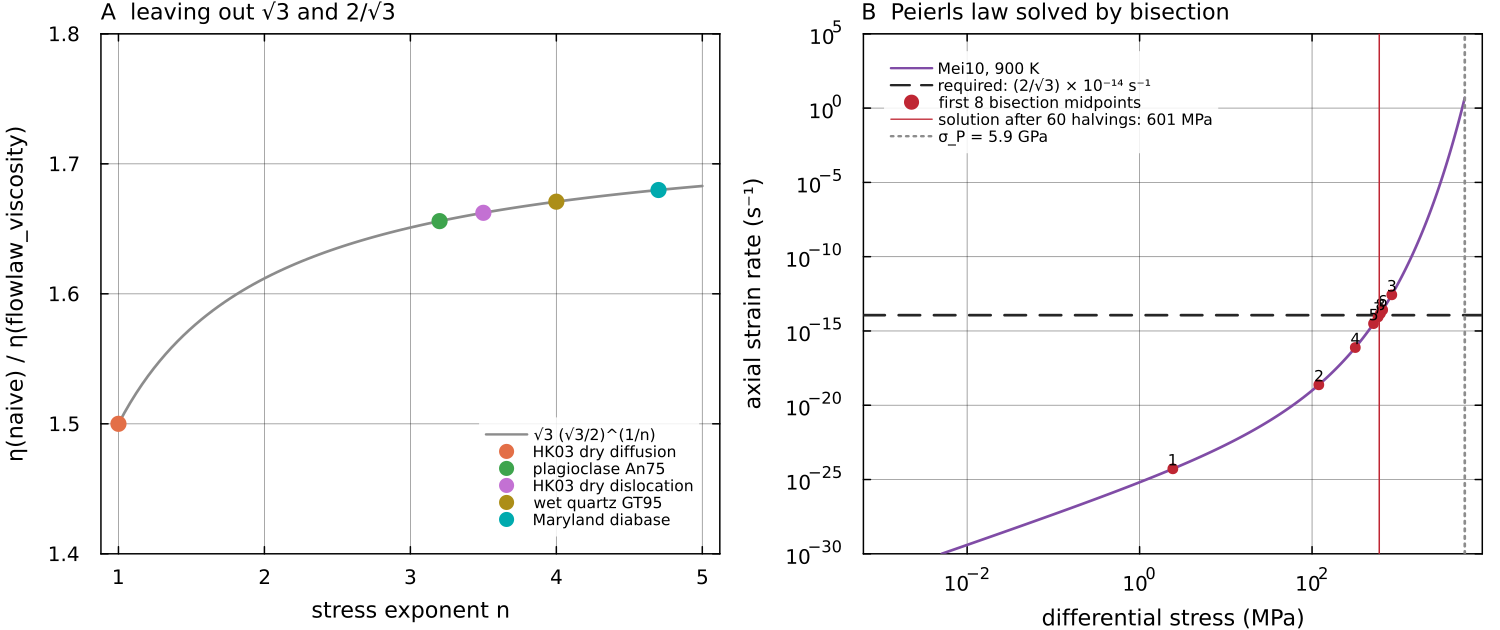
Left: the viscosity obtained by putting flowlaw_viscosity returns, for five presets (1300 K, 1 GPa, flowlaw_strainrate of the Mei et al. (2010) law at 900 K and 1 GPa, the strain rate required for flowlaw_viscosity runs between 1 kPa and docs/scripts/fig_flow_laws_sections.jl.
Olivine
| Key | Mechanism | ||||||
|---|---|---|---|---|---|---|---|
HK03_dry_olivine_diffusion | diffusion | 1.5×10⁹ MPa⁻¹ µm³ s⁻¹ | 1 | 3 | 375 | 6 (paper: 2-10) | |
HK03_wet_olivine_diffusion | diffusion, | 2.5×10⁷ | 1 | 3 | 1 | 375 | 10 (paper: 0-20) |
HK03_wet_olivine_diffusion_COH | diffusion, | 1.0×10⁶ | 1 | 3 | 1 | 335 | 4 |
HK03_dry_olivine_dislocation | dislocation | 1.1×10⁵ MPa⁻³·⁵ s⁻¹ | 3.5 | 530 | 15 (paper: 5-27, Table 2) | ||
HK03_wet_olivine_dislocation | dislocation, | 1600 | 3.5 | 1.2 | 520 | 22 | |
HK03_wet_olivine_dislocation_COH | dislocation, | 90 | 3.5 | 1.2 | 480 | 11 | |
HK03_dry_olivine_GBS_lowT | GBS, T < 1250 °C | 6500 MPa⁻³·⁵ µm² s⁻¹ | 3.5 | 2 | 400 | 15 | |
HK03_dry_olivine_GBS_highT | GBS, T > 1250 °C | 4.7×10¹⁰ | 3.5 | 2 | 600 | 15 | |
KW93_dry_olivine_diffusion | diffusion | 8.7×10¹⁵ s⁻¹ | 1 | 2.5 | 300 | 6 | |
KW93_wet_olivine_diffusion | diffusion, water-saturated | 5.3×10¹⁵ s⁻¹ | 1 | 2.5 | 240 | 5 | |
KW93_dry_olivine_dislocation | dislocation | 3.5×10²² s⁻¹ | 3.5 | 540 | 20 (paper: 15-25) | ||
KW93_wet_olivine_dislocation | dislocation, water-saturated | 2.0×10¹⁸ s⁻¹ | 3.0 | 430 | 15 (paper: 10-20) |
Hirth & Kohlstedt (2003), Table 1 (and Table 2 for tests/test_flow_laws.jl reproduces (7.82×10⁻¹⁵ and 2.48×10⁻¹² s⁻¹ against 7.8×10⁻¹⁵ and 2.5×10⁻¹²). Karato & Wu (1993) use the normalised form; Korenaga & Karato (2008, Table 3) quote their prefactors in MPa and µm units with the diffusion and dislocation values swapped, and the assignment here follows the original.
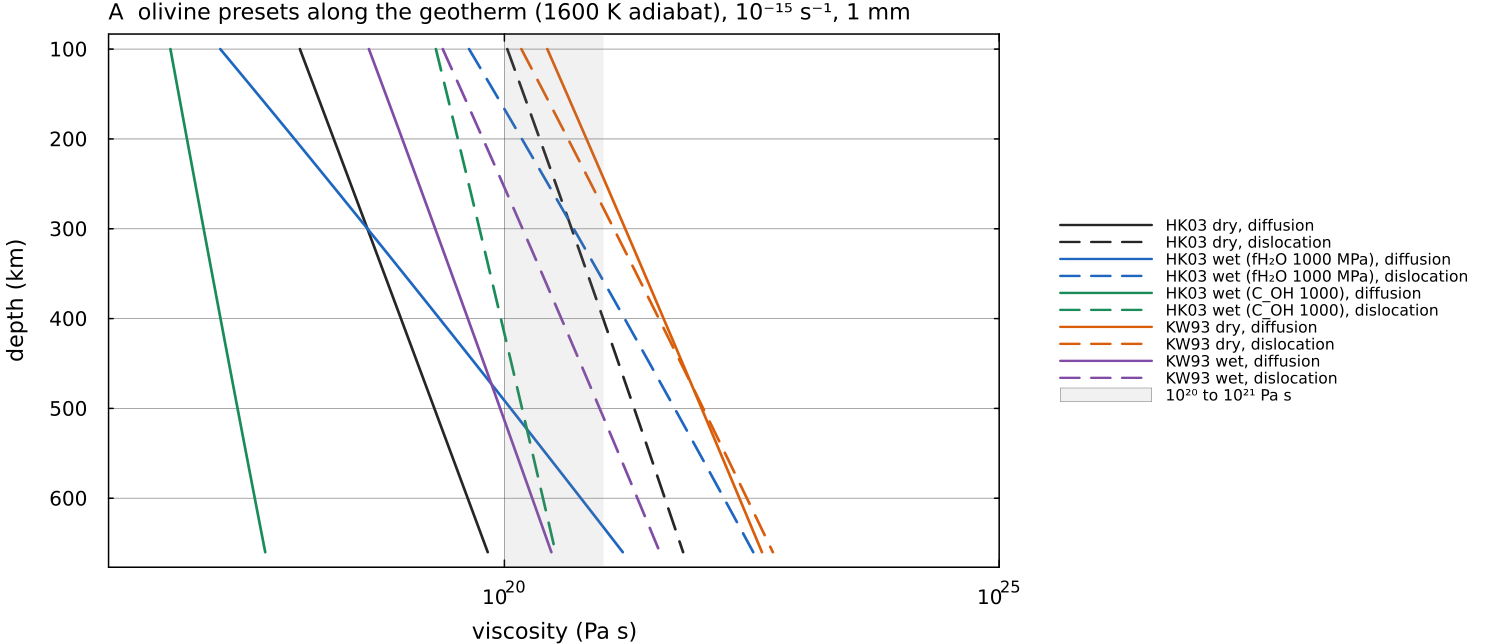
Every olivine preset evaluated with flowlaw_viscosity on the adiabat of 1600 K potential temperature from 100 to 660 km, at docs/scripts/fig_flow_laws_sections.jl.
Crust
| Key | Rock | Checked | ||||||
|---|---|---|---|---|---|---|---|---|
MZK98_maryland_diabase | diabase, dry | 8 MPa⁻⁴·⁷ s⁻¹ | 4.7 | 485 | secondary | |||
MZK98_columbia_diabase | diabase, dry | 190 MPa⁻⁴·⁷ s⁻¹ | 4.7 | 485 | ||||
RD00_dry_anorthite_diffusion | anorthite, dry | 10¹²·¹ MPa⁻¹ µm³ s⁻¹ | 1 | 3 | 467 | original | ||
RD00_wet_anorthite_diffusion | anorthite, 0.07 wt% H₂O | 10¹·⁷ | 1 | 3 | 170 | original | ||
RD00_dry_anorthite_dislocation | anorthite, dry | 10¹²·⁷ MPa⁻³ s⁻¹ | 3 | 648 | original | |||
RD00_wet_anorthite_dislocation | anorthite, 0.07 wt% H₂O | 10²·⁶ | 3 | 356 | original | |||
R06_dry_anorthite_diffusion | anorthite, dry | 10¹²·¹ | 1 | 3 | 460 | 24 | original | |
R06_wet_anorthite_diffusion | anorthite, | 10⁻⁰·⁷ | 1 | 3 | 1 | 159 | 38 | original |
R06_dry_anorthite_dislocation | anorthite, dry | 10¹²·⁷ | 3 | 641 | 24 | original | ||
R06_wet_anorthite_dislocation | anorthite, | 10⁰·² | 3 | 1 | 345 | 38 | original | |
Ranalli95_plagioclase_An75 | plagioclase An75 | 3.3×10⁻⁴ MPa⁻³·² s⁻¹ | 3.2 | 238 | secondary | |||
GT95_wet_quartz | quartz, wet, melt-bearing | 1.1×10⁻⁴ MPa⁻⁴ s⁻¹ | 4 | 223 | secondary | |||
HTD01_wet_quartzite | quartzite, | 10⁻¹¹·² MPa⁻⁵ s⁻¹ | 4 | 1 | 135 | original |
Mackwell, Zimmerman & Kohlstedt (1998) measured both diabases for Venus; the Columbia law is the weaker one and the one Venus plateau studies usually take. Rybacki & Dresen (2000) fit at a single confining pressure and give no
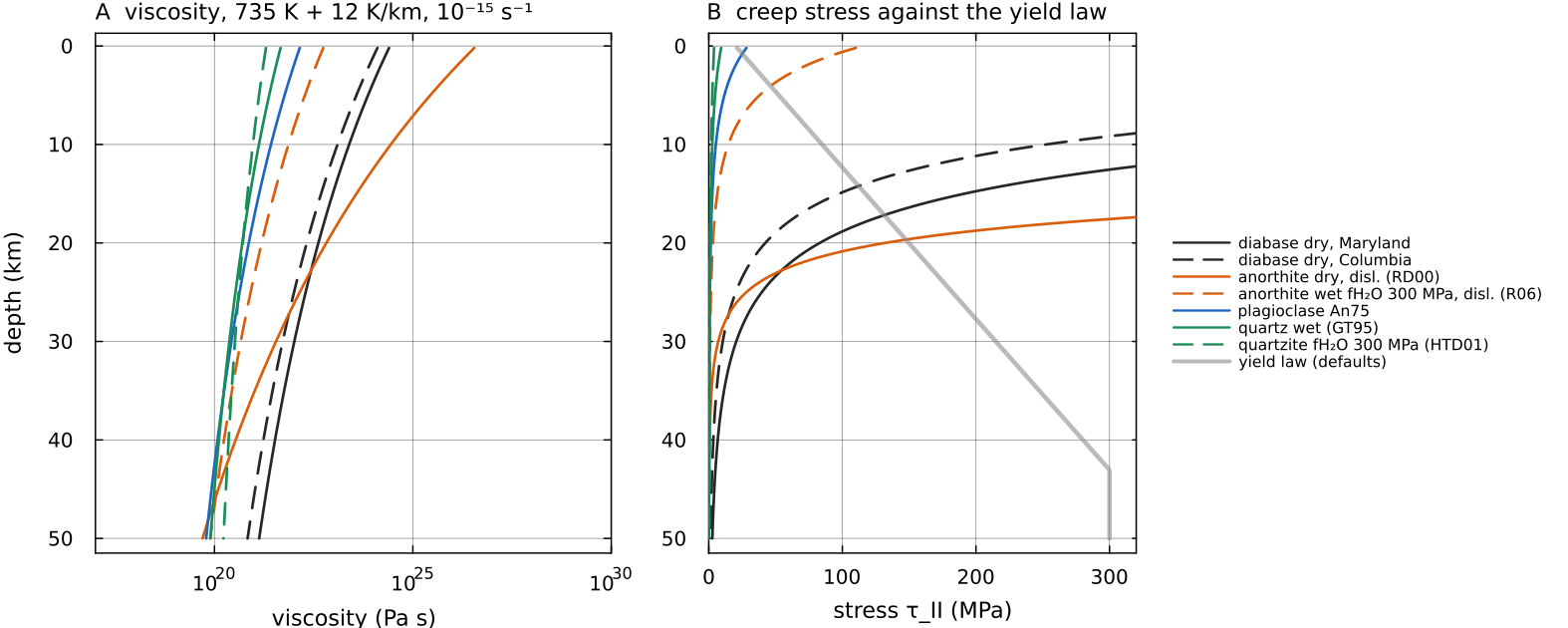
The crustal presets through a 50 km crust with a 735 K surface and 12 K/km, at flowlaw_viscosity with the lithostatic pressure of mantle_pressure. Left: viscosity. Right: the creep stress against the default yield law. The dry diabases and dry anorthite carry hundreds of megapascals in the upper 15 to 22 km and so yield there, while the plagioclase An75 and quartz laws are weak at every depth. Script: docs/scripts/fig_flow_laws_sections.jl.
Peierls (low-temperature) plasticity of olivine
| Key | Checked | ||||||
|---|---|---|---|---|---|---|---|
Mei10_olivine_peierls (default) | 1.4×10⁻⁷ MPa⁻² s⁻¹ | 2 | 320 | 5.9 | 1/2 | 1 | original |
Goetze78_olivine_peierls | 5.7×10¹¹ s⁻¹ | 0 | 540 | 8.5 | 1 | 2 | Molnar (2020) |
EG79_olivine_peierls | 1.3×10¹² s⁻¹ | 0 | 500 | 9.1 | 1 | 2 | Molnar (2020), Mei et al. (2010) |
Idrissi16_olivine_peierls | 1.0×10⁶ s⁻¹ | 0 | 566 | 3.8 | 1/2 | 2 | Molnar (2020) |
Raterron04_olivine_peierls | 2.6×10¹⁶ s⁻¹ | 0 | 564 | 15.4 | 2/3 | 2 | Molnar (2020) |
Goetze (1978) is the set behind most convection codes (Kameyama et al. 1999); 8.5 GPa and 540 kJ/mol belong to it, 9.1 GPa and 500 kJ/mol to Evans & Goetze (1979). The laws with
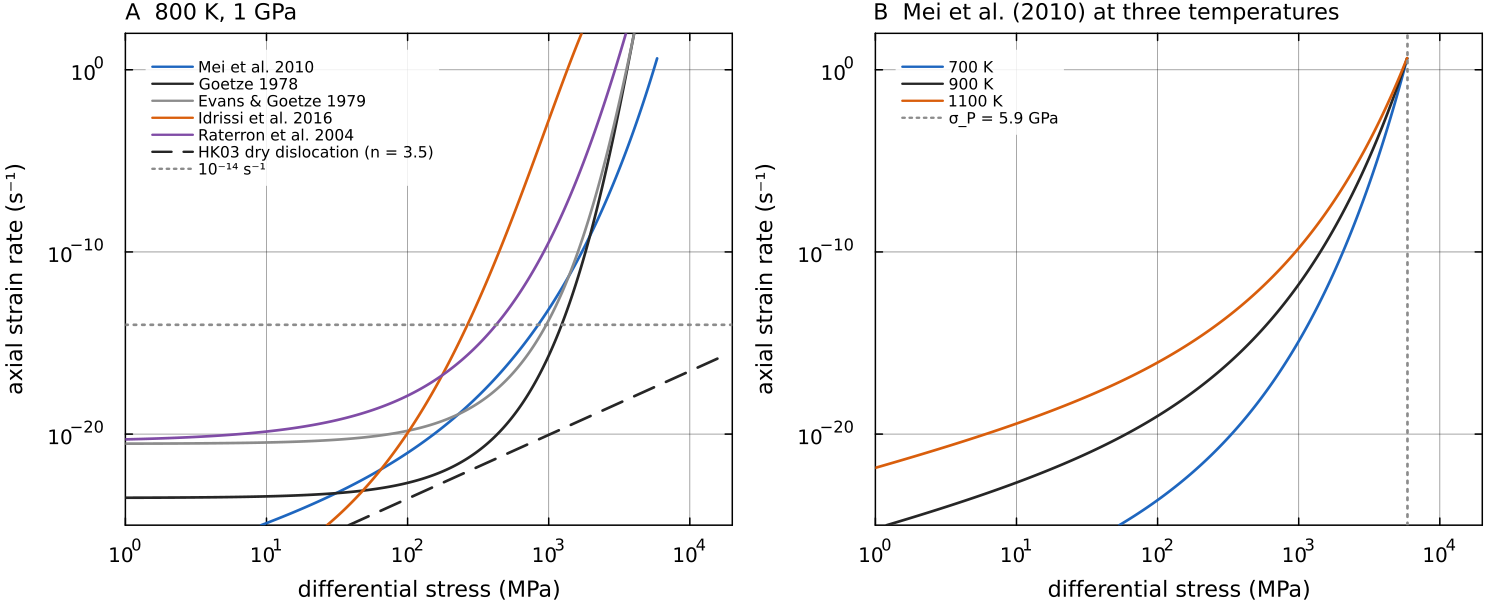
flowlaw_strainrate of the five Peierls presets at 800 K and 1 GPa, against Hirth & Kohlstedt (2003) dry dislocation creep, up to each law's Peierls stress (left), and of the default Mei et al. (2010) law at 700, 900 and 1100 K (right). The docs/scripts/fig_flow_laws_sections.jl.
Laws documented but not presets
Hansen et al. (2019), olivine low-temperature plasticity with a grain-size (Hall-Petch) strength and a strain-dependent back stress:
, , s⁻¹, kJ/mol, GPa, GPa µm^1/2 (doi 10.1029/2018JB016736). Its back stress is a strain history MILEVA does not track. Demouchy et al. (2013), single-crystal olivine (PEPI 220, 37-49): the original was not readable, so no values are given.
Tielke et al. (2016, 2017), olivine single-slip-system laws: aggregate convection needs aggregate laws.
Tian et al. (2023), Venus: a normalised viscosity
with Pa s at 1600 K and for plagioclase, reached in MILEVA through the reference-viscosity laws of Rheology.
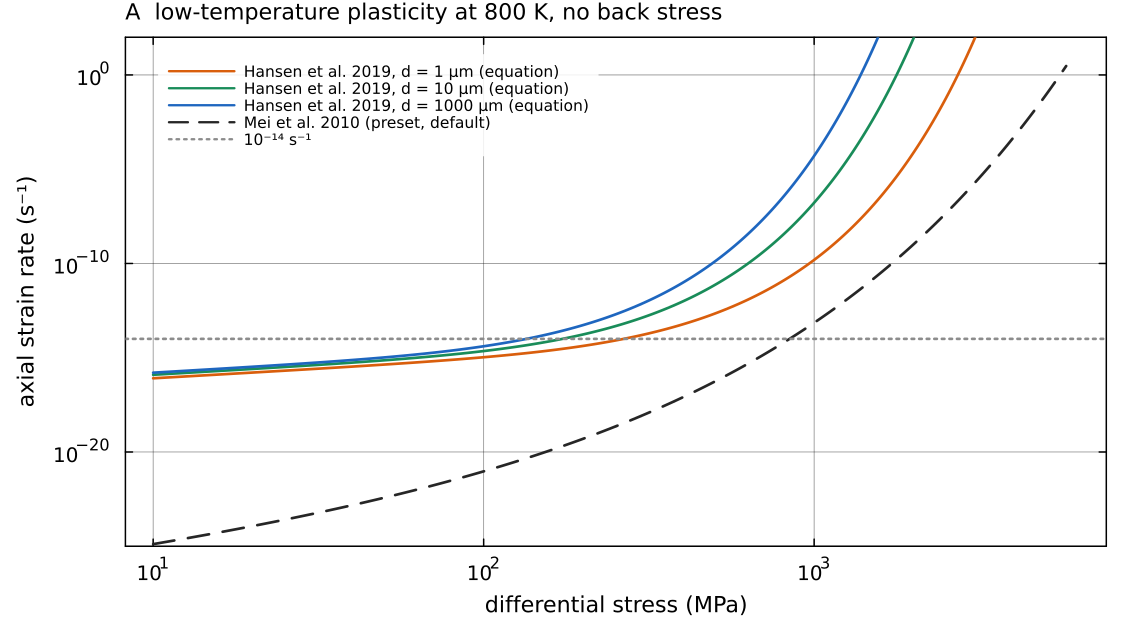
The Hansen et al. (2019) law evaluated from the equation above with zero back stress, at 800 K, for grain sizes of 1, 10 and 1000 µm; this curve is written out in the script because the law is not a preset. The dashed line is the default Mei et al. (2010) preset from flowlaw_strainrate at the same temperature. Smaller grains are stronger (Hall-Petch), and without the back stress the law is weaker than the preset at every stress shown. Script: docs/scripts/fig_flow_laws_sections.jl.
Assumptions and simplifications
The laws are used as their papers print them; the choices MILEVA makes lie in how they are applied.
Steady-state, isotropic creep. Each law describes steady-state flow of a randomly oriented aggregate. Transient creep after a change of stress and the directional weakness of a deformed, aligned aggregate are not represented.
One law per mechanism for the whole mantle. The selected laws, measured on olivine or its crustal counterparts, are evaluated at every depth. Below
cfg.depth660kmthe lower mantle differs from them only bycfg.eta660kmFactor(withcfg.use660kmJump) and through the pressure term; there is no separate law for lower-mantle minerals. Mechanisms combined at a common strain rate. Strictly, parallel mechanisms share the stress and their strain rates add. The harmonic sum of viscosities, each evaluated at the cell's total strain rate, is exact for Newtonian laws and where one mechanism dominates, and otherwise underestimates the viscosity somewhat; for two identical laws with
contributing equally the factor is . Water as a fixed parameter. The water measure is one constant for the mantle and one for the crust. It is not computed from pressure and temperature, not transported and not removed by melting. The Peierls law is evaluated dry (
), and the water-saturated Karato & Wu (1993) laws carry their water in the prefactor. Grain size. It is 1 mm (
mat.flowlaw_grain_size) unlesscfg.evolveGrainSizesupplies it from the markers.Melt. The melt-fraction factor
of Hirth & Kohlstedt (2003) is not applied, so partial melt does not weaken the creep laws. Peierls plasticity only where it can matter. It is evaluated only where
K; at higher temperature creep is weaker by many orders of magnitude. Pressure. The activation-volume term uses the lithostatic pressure of
mantle_pressure, not the dynamic pressure of the Stokes solution.Crust. Where there is basalt the crustal law is blended with the mantle law in
by the basalt fraction, rather than treating the two as separate phases.
Extrapolation
Laboratory tests run at strain rates many orders of magnitude faster than mantle flow, and usually at higher stresses and smaller grain sizes (Karato & Wu 1993; Hirth & Kohlstedt 2003). Applying a law in a convection model extrapolates it along its fitted exponents, so the activation volume, the water content and the grain size, all of which carry wide ranges, control the absolute viscosity more than the choice between well-calibrated presets.
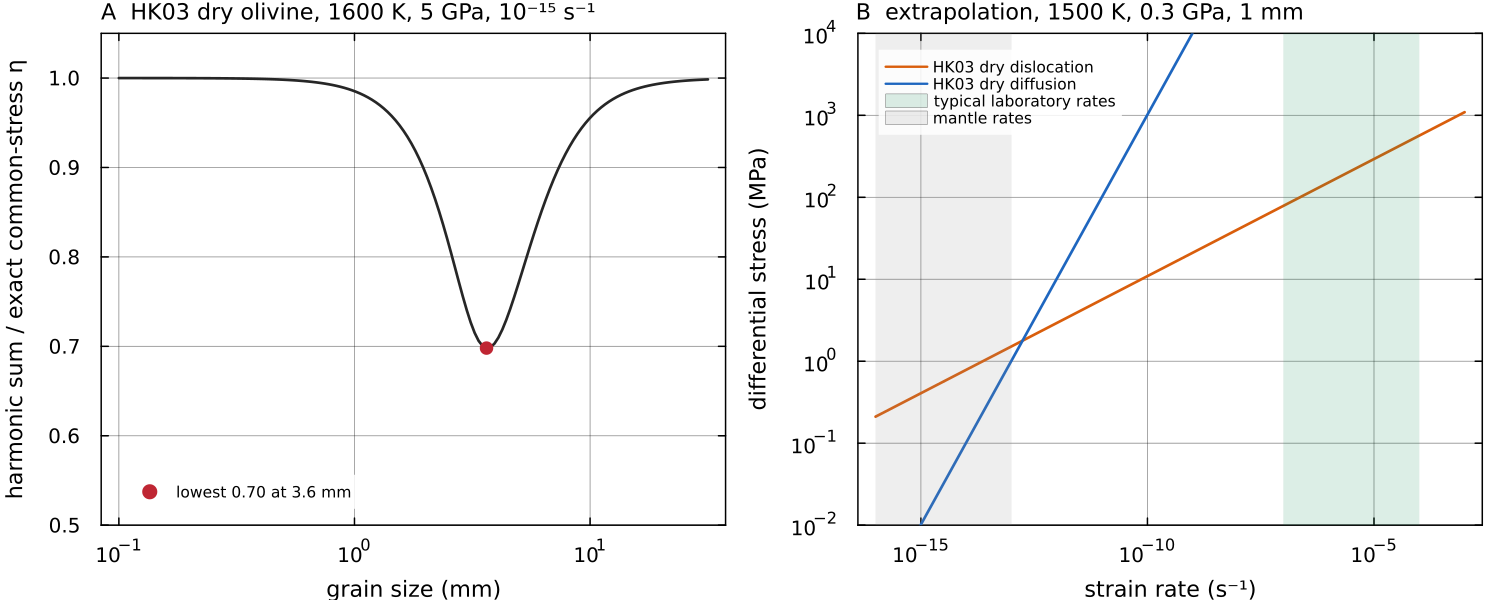
Left: the harmonic sum of the Hirth & Kohlstedt (2003) dry olivine viscosities, each at the cell's strain rate, divided by the exact parallel combination in which both share one stress and their strain rates add (solved by bisection on flowlaw_strainrate), at 1600 K, 5 GPa and docs/scripts/fig_flow_laws_sections.jl.
Where in the code
| Topic | File | Function or field |
|---|---|---|
| Presets and evaluation | physics/flow_laws.jl | FLOW_LAWS, flow_law, flowlaw_strainrate, flowlaw_viscosity, gbs_viscosity |
| Use in the rheology | physics/composite_rheology.jl | composite_rheology |
| Selection | config/MaterialProperties.jl | flowlaw_* |
| Tests | tests/test_flow_laws.jl | paper examples, inversion of every preset, use in the rheology |
Further reading
Frost, H. J. & Ashby, M. F. (1982), Deformation-Mechanism Maps: The Plasticity and Creep of Metals and Ceramics, Pergamon Press. The origin of the mechanism map.
Karato, S. & Wu, P. (1993), Rheology of the upper mantle: a synthesis, Science 260, 771-778, doi:10.1126/science.260.5109.771.
Kohlstedt, D. L., Evans, B. & Mackwell, S. J. (1995), Strength of the lithosphere: constraints imposed by laboratory experiments, J. Geophys. Res. 100, 17587-17602, doi:10.1029/95JB01460.
Solomatov, V. S. (1995), Scaling of temperature- and stress-dependent viscosity convection, Phys. Fluids 7, 266-274, doi:10.1063/1.868624.
Ranalli, G. (1995), Rheology of the Earth, 2nd ed., Chapman & Hall.
Mackwell, S. J., Zimmerman, M. E. & Kohlstedt, D. L. (1998), High-temperature deformation of dry diabase with application to tectonics on Venus, J. Geophys. Res. 103, 975-984, doi:10.1029/97JB02671.
Schubert, G., Turcotte, D. L. & Olson, P. (2001), Mantle Convection in the Earth and Planets, Cambridge University Press, doi:10.1017/CBO9780511612879.
Hirth, G. & Kohlstedt, D. L. (2003), Rheology of the upper mantle and the mantle wedge: a view from the experimentalists, in Inside the Subduction Factory, Geophys. Monogr. 138, 83-105, AGU, doi:10.1029/138GM06.
Karato, S. (2008), Deformation of Earth Materials: An Introduction to the Rheology of Solid Earth, Cambridge University Press, doi:10.1017/CBO9780511804892.
Bürgmann, R. & Dresen, G. (2008), Rheology of the lower crust and upper mantle: evidence from rock mechanics, geodesy, and field observations, Annu. Rev. Earth Planet. Sci. 36, 531-567, doi:10.1146/annurev.earth.36.031207.124326.
Grott, M. & Breuer, D. (2008), The evolution of the martian elastic lithosphere and implications for crustal and mantle rheology, Icarus 193, 503-515, doi:10.1016/j.icarus.2007.08.015.
Mei, S., Suzuki, A. M., Kohlstedt, D. L., Dixon, N. A. & Durham, W. B. (2010), Experimental constraints on the strength of the lithospheric mantle, J. Geophys. Res. 115, B08204, doi:10.1029/2009JB006873.
Turcotte, D. L. & Schubert, G. (2014), Geodynamics, 3rd ed., Cambridge University Press, doi:10.1017/CBO9780511843877.
Gerya, T. (2019), Introduction to Numerical Geodynamic Modelling, 2nd ed., Cambridge University Press, doi:10.1017/9781316534243.
Seiff, A., Schofield, J. T., Kliore, A. J., Taylor, F. W. et al. (1985), Models of the structure of the atmosphere of Venus from the surface to 100 kilometers altitude, Adv. Space Res. 5, 3-58, doi:10.1016/0273-1177(85)90197-8.