Isoviscous convection, Ra = 10⁴ to 10⁶ (2-D)
Basally heated, isoviscous, Boussinesq convection in the spherical annulus, the canonical problem of Hernlund & Tackley (2008). One driver covers the three Rayleigh numbers; the Rayleigh number sets the vigour of the flow, the thickness of the thermal boundary layers and how many plumes the annulus holds, and above about 10⁵ the flow is time dependent.
This page is the "look at the flow" companion of the verification driver benchmarks/hernlund_tackley_annulus.jl. The physics and the set-up are the same; the example writes VTK frames and figures and is shorter by default, the benchmark carries the reference tables and a convergence guard. Quote numbers from the benchmark, as described in Benchmarks.
The model
with constant eta_for_Ra in examples/common_2d.jl), free-slip walls, cfg.removeNetRotation). The equations and their discretisation are described in Governing equations and Discretization.
| parameter | value | where |
|---|---|---|
| geometry | spherical annulus, | ht_shell! |
| grid | Nr × 8 Nr, uniform in radius (default 64 × 512) | ht_shell! |
| Ra | eta_for_Ra | |
| 1000 K | ||
| temperature transport | markers, with the grid diffusion increment handed back (Crank-Nicolson, | Markers |
| Stokes solver | MUMPS direct | cfg.solverType = "mumps" |
| initial condition | linear ramp, | _initial_temperature_2d in markers/init_markers.jl |
dtMax | CFL controls once convection starts | |
| run length | 0.3 thermal diffusion times, about 9500 Myr | cfg.maxTimeMyr |
| output | VTK and figures every 2000 steps, diagnostics.csv every 500 |
Planform
At these Rayleigh numbers the annulus supports several stable planforms, and the seeded wavenumber
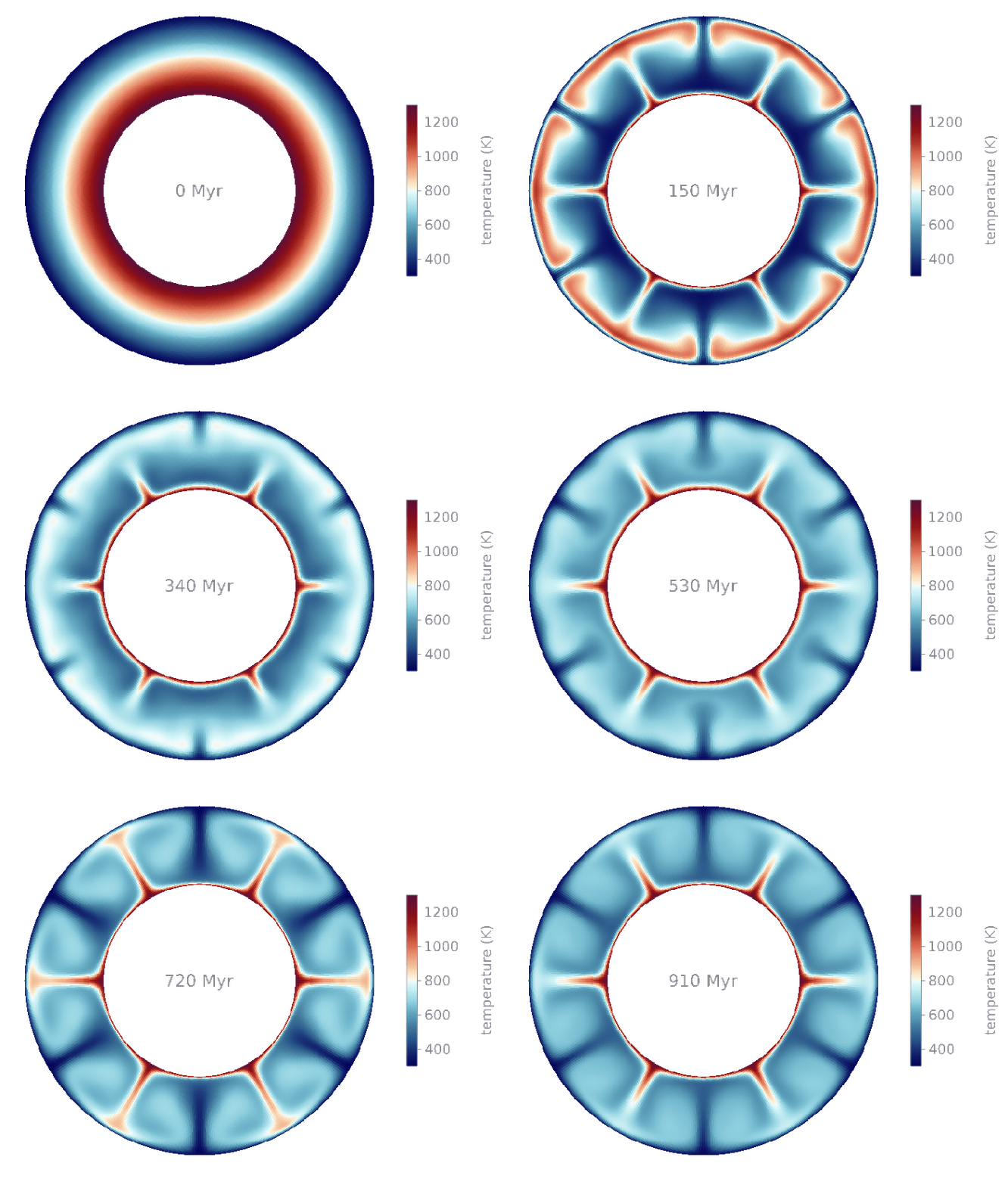
A short preview run of the driver at Ra = 10⁵, seeded m = 6, 64 × 512 (3000 steps, 0 to 910 Myr of model time, about 0.03 diffusion times; a frame every 60 steps): temperature, cold blue to hot red. The seeded perturbation grows into six hot upwellings within the first 100 Myr; the cold boundary layer then drips between them and the flow settles into a time-dependent pattern of narrow plumes and cold sheets. This is far shorter than the 0.3 diffusion times the driver runs by default, so it shows the onset, not a statistically steady state; take numbers from the full run.
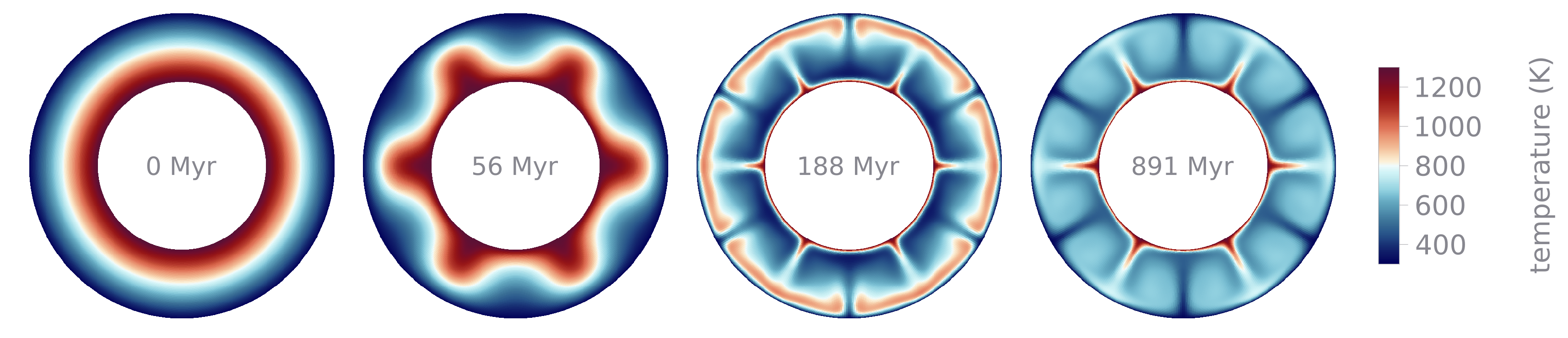
The same run at 0, 56, 188 and 891 Myr.
Running it
Locally, one Rayleigh number at a time:
export GKSwstype=nul                      # headless figure rendering
julia --project=. -t 4 examples/annulus_convection_2d.jl 1e5 64 6
Arguments are Ra Nr m. Shorten a run with MILEVA_MAXTIME_MYR or MILEVA_MAXSTEPS, and redirect it with MILEVA_OUTDIR. Output goes to output/examples/annulus_Ra1e+05_N64_m6/.
On a cluster, hpc/annulus_convection_2d.slurm runs all three Rayleigh numbers as a SLURM array (see Running on HPC):
sbatch hpc/annulus_convection_2d.slurmAt the end the driver prints the mean of
What to expect
The numbers below were measured with the benchmark driver.
Ra = 10⁴: steady convection. With the benchmark driver at Nr = 64,
, MILEVA measured Nu = 4.14 and = 35.1 against the published 4.18 and 37.7. The isoviscous Ra = 10⁴ case settles at about 0.3 diffusion times, which is this example's cap; for a converged number use the benchmark driver, which runs to 0.6. Ra = 10⁵: time-dependent convection with thinner boundary layers, and more than one stable planform. Seeded with
, the benchmark driver settles into the three plumes of the published run and measures Nu = 7.70 and = 161.8 against 7.39 and 160. Seeded with it keeps more, narrower cells and Nu = 8.88, about 20 % higher; see Benchmarks. Ra = 10⁶: strongly time dependent flow with many thin plumes; the published annulus values are Nu = 14.4 and
= 640. Use Nr = 128 or more to resolve the boundary layers.
A useful internal check that needs no reference: in a statistically steady state the same power crosses every shell, so the time means of
Smoke test
A quick check that the driver runs:
MILEVA_MAXSTEPS=6 julia --project=. -t 2 examples/annulus_convection_2d.jl 1e5 16 66 steps at 16 × 128 in 41 s of wall time, most of it compilation; temperature and velocity finite throughout. At the default 64 × 512 grid, 40 steps took 0.41 s per step and 2.3 GB.