Damage, softening and healing
MILEVA has two independent ways of weakening material that has deformed:
| mechanism | state variable | weakens | heals | switch |
|---|---|---|---|---|
| grid damage | the whole viscosity, by up to damage_max_weakening | yes, over damage_heal_time | cfg.useDamage | |
| strain weakening | accumulated strain eps_acc on the markers | the cohesion of the yield stress | no | cfg.useFullPlasticity with cfg.strainWeakeningFactor > 1 |
Both default off.
Physical background
Why deformation history matters
A viscosity law of the kind described on the rheology page depends on the present state of a parcel, that is its temperature, pressure, composition and strain rate. Real rocks also remember how they have deformed. A shear zone that has accommodated large strain is weaker than the same rock next to it, because deformation has reduced its grain size, aligned its minerals, ground its fault surfaces smooth or let fluids and melt in. Once formed, such a zone stays weak for some time after the deformation that created it has stopped, and can be reactivated later.
This memory matters most at the top of a convecting planet. A cold lithosphere following an Arrhenius law is many orders of magnitude stiffer than the mantle beneath it, and on its own it forms a single immobile lid, the stagnant-lid regime that is thought to describe Venus at present (Solomatov & Moresi 1996). Earth's lithosphere instead is broken into plates that are wide and rigid in their interiors but separated by narrow, weak boundaries. Plate velocities are a few centimetres per year (Schubert, Turcotte & Olson 2001), and a plate boundary that takes 5 cm/yr of relative motion across a zone of order 50 km width shears at roughly
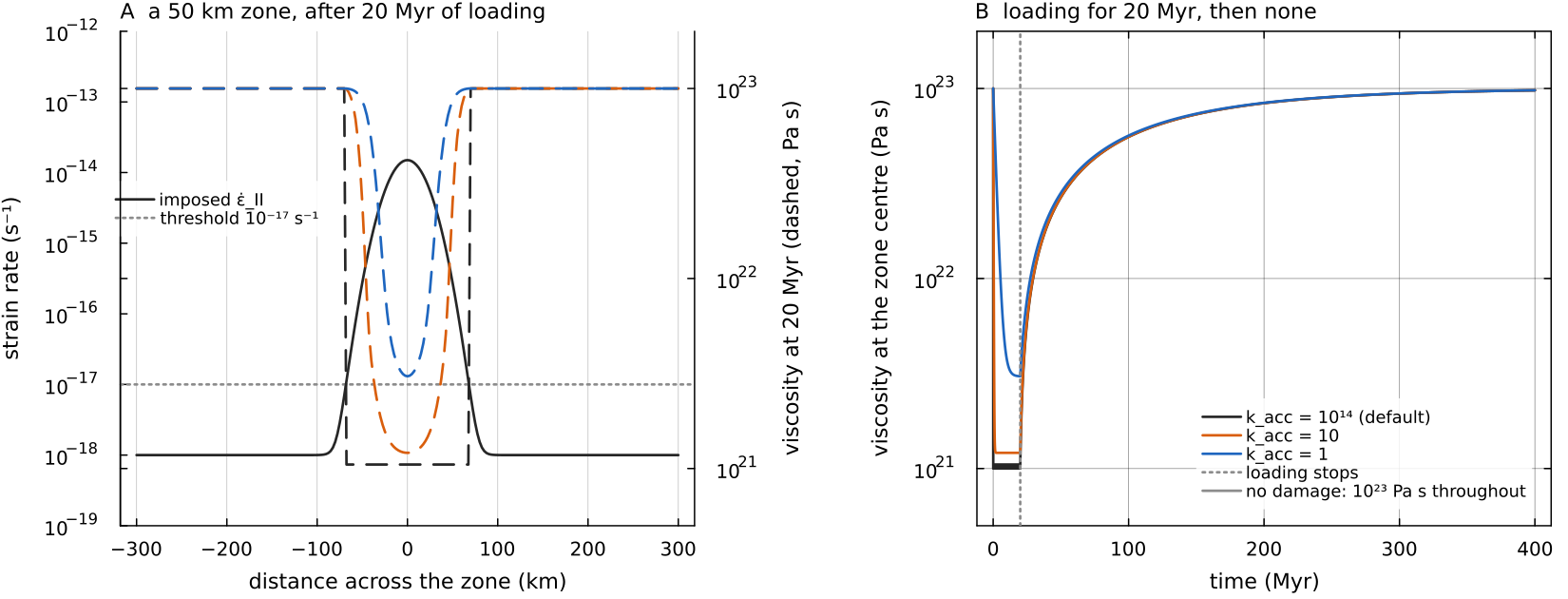
Grid damage on a row of cells across a 50 km wide zone of a evolve_damage! and apply_damage_to_viscosity! every 50 kyr. A: the imposed strain rate and the viscosity after 20 Myr (dashed) for three accumulation rates; the default weakens every cell above the threshold by the full factor 100. B: the viscosity at the zone centre. When the deformation stops the zone stays weak and recovers over the 100 Myr healing time, so it outlives the flow that made it. Script: docs/scripts/fig_damage_sections.jl.
Weakening mechanisms in rocks
Several microphysical processes weaken deforming rock, and they act in different parts of the lithosphere.
Loss of cohesion and friction in the brittle regime. At shallow depth rock strength is limited by frictional sliding on fractures, described to first order by Byerlee's law, a shear stress of about
for normal stresses below 200 MPa and of about above it (Byerlee 1978). As a fault accumulates offset its cohesion and effective friction can fall. Continuum models represent this as cohesion or friction that decreases with accumulated plastic strain (Lavier, Buck & Poliakov 2000; Huismans & Beaumont 2003). Grain-size reduction in the ductile regime. Dynamic recrystallisation during dislocation creep reduces the grain size, which in turn speeds up grain-size-sensitive diffusion creep and lowers the viscosity. This is the basis of the grain-damage theory of Bercovici & Ricard (2012) and of the damage equation for grain size of Rozel, Ricard & Bercovici (2011). MILEVA models it explicitly on the grain size page.
Fabric and other effects. The development of a fabric, in which weak phases become aligned and interconnected, can weaken ductile shear zones (Montési 2013). Shear heating, fluids and melt act in the same direction.
Opposing all of these is healing. Grain growth, crack sealing and the re-equilibration of fabrics return the rock towards its undeformed strength. The balance between damage and healing decides whether weak zones are persistent features or short-lived ones. In convection models with damage the occurrence of plate-like behaviour depends on that balance, and a hotter surface, which speeds up healing, favours a stagnant lid (Landuyt & Bercovici 2009; Foley, Bercovici & Landuyt 2012). This is one proposed reason why Venus, with a surface several hundred kelvin hotter than Earth's, lacks plate tectonics.
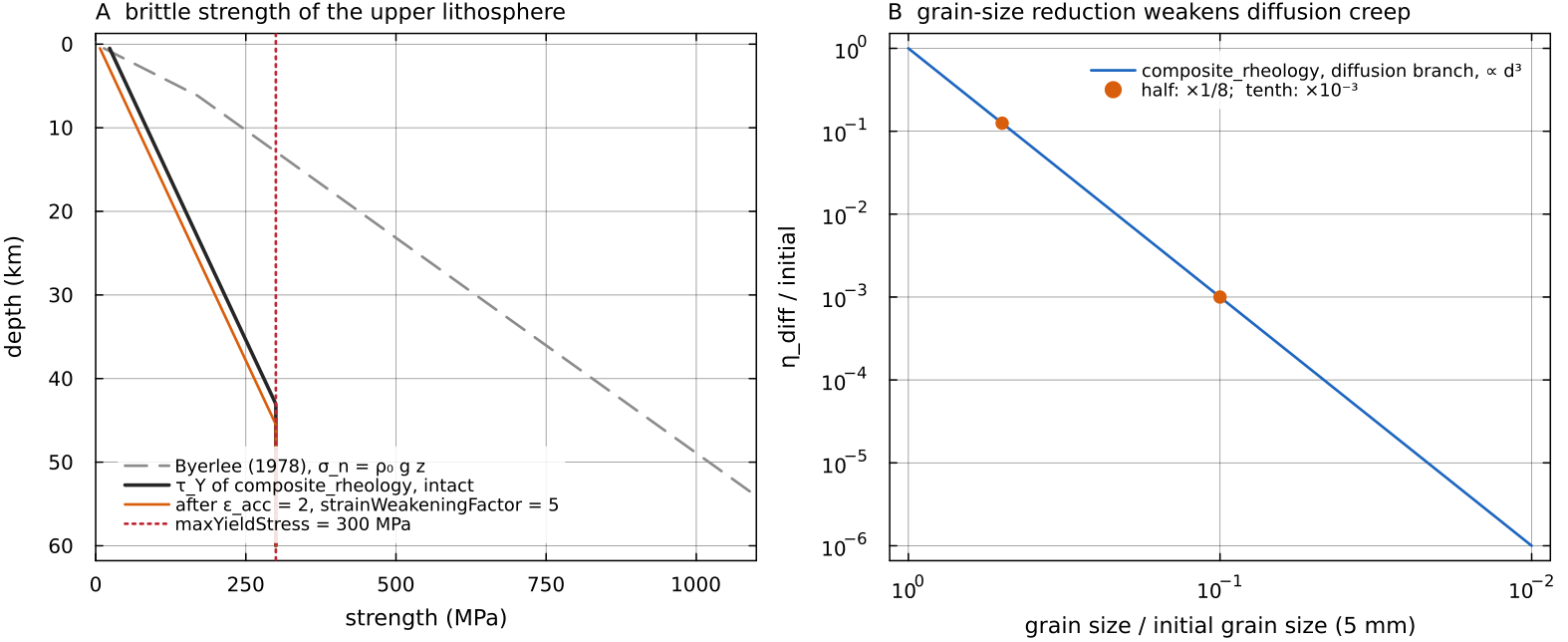
A: Byerlee's law with the normal stress taken as composite_rheology (creep branches switched off, default cohesion 20 MPa and friction 0.2, cap 300 MPa), intact and after an accumulated strain of 2 with strainWeakeningFactor = 5. Cohesion loss lowers the strength near the surface by 16 MPa and matters little where friction dominates. B: the diffusion-creep viscosity of composite_rheology against grain-size reduction at 1400 K and 60 km: halving the grains weakens the rock eight times, a tenfold reduction a thousand times. Script: docs/scripts/fig_damage_sections.jl.
How MILEVA represents them
MILEVA does not model these microphysical processes one by one in the two mechanisms on this page. Each is a phenomenological state variable that stands for their combined effect.
Grid damage is a single number
between 0 (intact) and 1 (fully damaged) per cell. It grows where the strain rate exceeds a threshold, heals exponentially with a fixed time constant, and multiplies the whole viscosity. It has the structure of the damage models used to generate plates in convection calculations (Bercovici & Ricard 2012; Foley, Bercovici & Landuyt 2012), but is driven by the strain rate rather than by the deformational work, and has no grain-size or pinning physics behind it. Strain weakening is the brittle-regime softening of the continuum lithosphere models, in which the accumulated strain carried by each marker lowers the cohesion of the yield stress (Lavier, Buck & Poliakov 2000; Huismans & Beaumont 2003). Strain-dependent weakening has also been used in global convection models (Tackley 2000, part 2). It never heals.
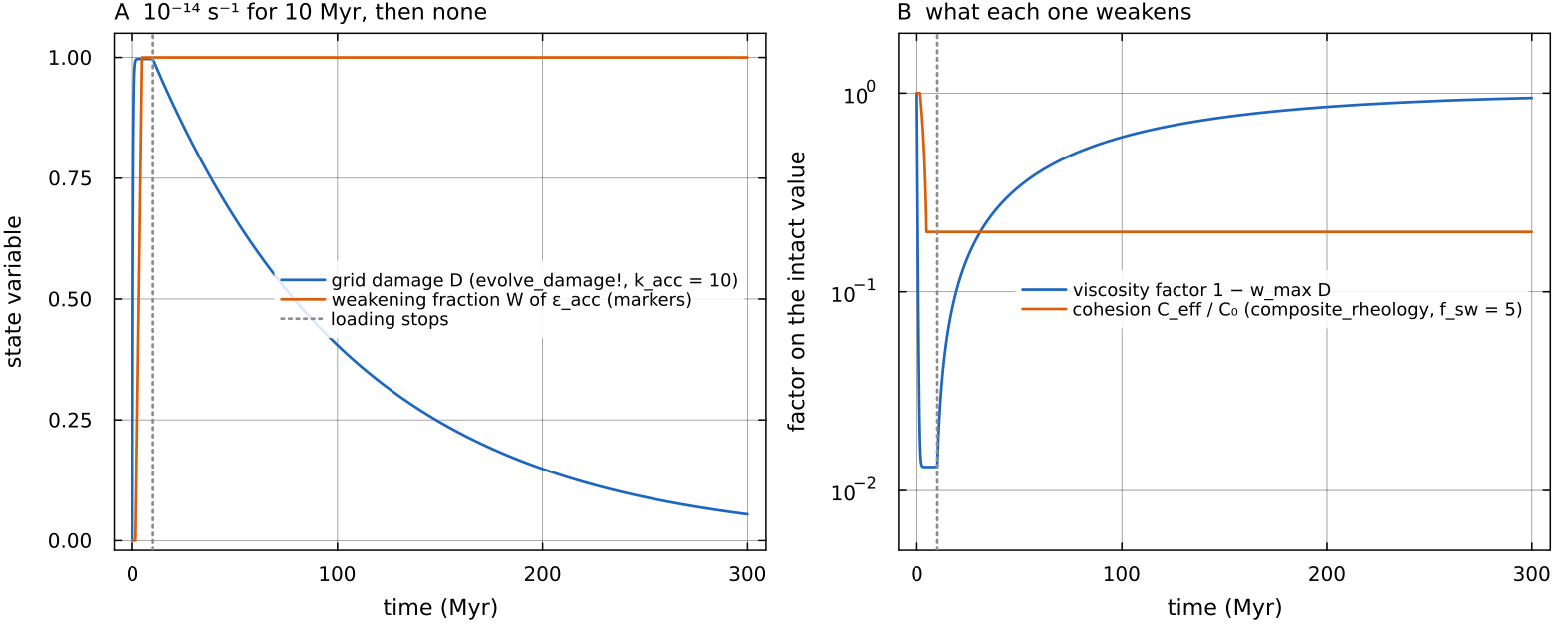
One cell deformed at evolve_damage! (composite_rheology with strainWeakeningFactor = 5 at 10 km. Script: docs/scripts/fig_damage_sections.jl.
Scales and dimensionless numbers
Three ratios control what grid damage does in a run.
Damage number. The product
compares the rate of damage accumulation with the rate of healing. Its steady state is (derived below). For the field stays close to zero; for it saturates at 1. Memory ratio. The healing time compared with the convective time scale, for example the time a parcel takes to cross the mantle, decides whether a weak zone outlives the flow that made it. With the default
Myr a zone abandoned by the flow stays weak for about that long. Threshold against the flow. The threshold
sets which parts of the domain can accumulate damage at all. As an order-of-magnitude estimate, a mantle flowing at 1 cm/yr over a length of 1000 km deforms at about s , so the default threshold of s lies below typical convective strain rates and above those of a rigid lid.
The strength of the weakening is set by
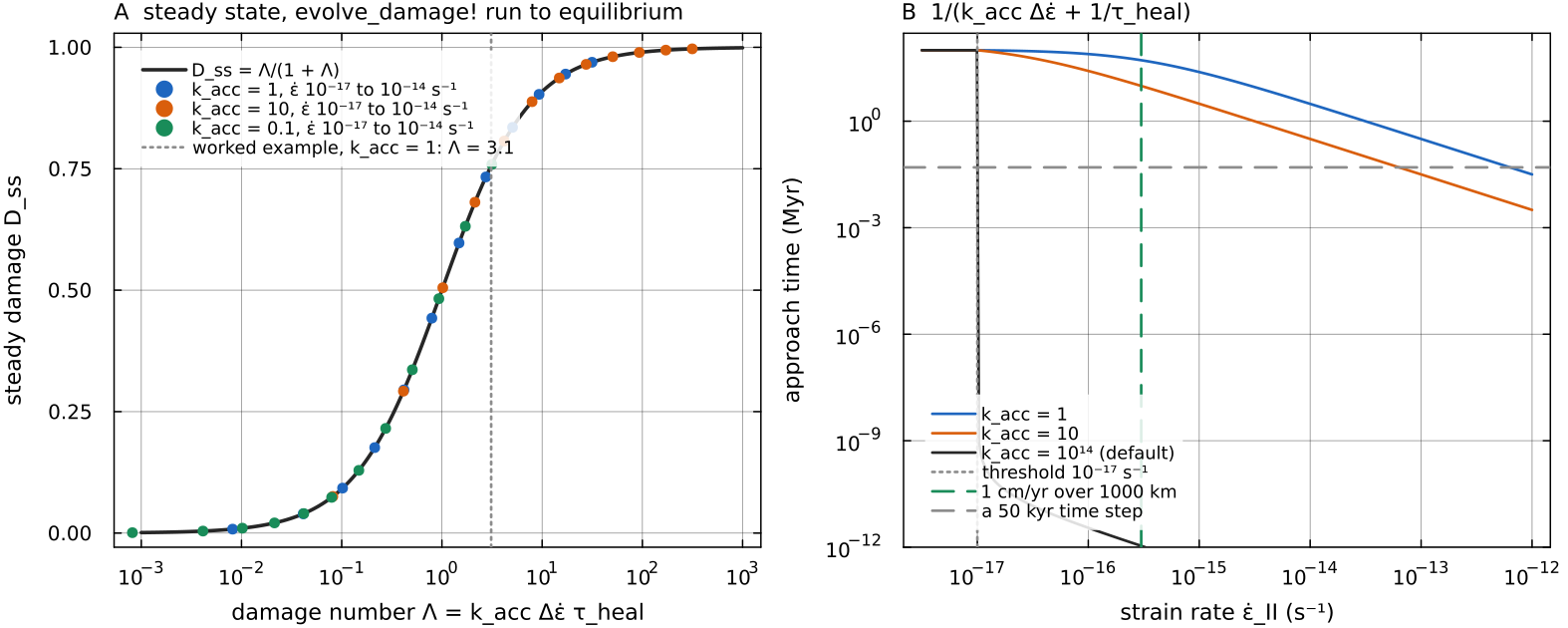
A: the steady damage of evolve_damage! run to equilibrium (1000 Myr in 50 kyr steps) at strain rates from just above the threshold to docs/scripts/fig_damage_sections.jl.
Grid damage
Every time step, each grid cell does a small piece of bookkeeping. It first asks how much faster it is deforming than a threshold strain rate. That excess drives damage up, while healing pulls damage back down in every cell, in proportion to the damage already there. Their difference is applied over one time step, the result is kept between 0 and 1, and the new damage then lowers the cell's viscosity before the flow is solved. The diagram follows one deforming cell and one quiet cell through these steps.
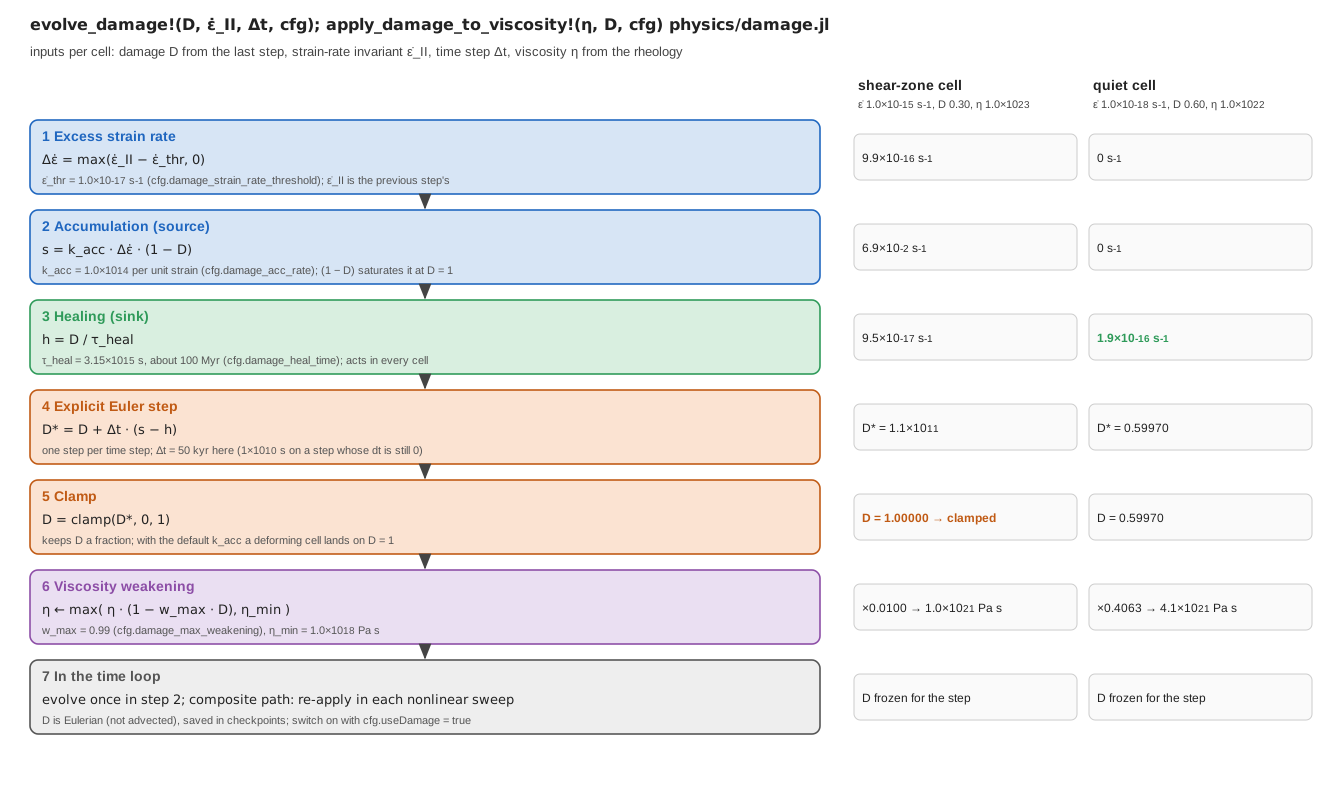
One time step of grid damage, stage by stage, with the default damage parameters and evolve_damage! and apply_damage_to_viscosity!. Script: docs/scripts/fig_damage_pipeline.jl.
physics/damage.jl carries a scalar damage field
accumulating where the strain-rate invariant exceeds the threshold and healing everywhere at rate evolve_damage! takes one explicit Euler step per time step and clamps apply_damage_to_viscosity! then reduces the viscosity,
so a fully damaged cell is
The symbols in these two equations are:
| symbol | meaning | units | set by |
|---|---|---|---|
| damage, 0 intact and 1 fully damaged | none | evolved, cell field damage | |
| second invariant of the strain-rate tensor, | s | grid field strainII | |
| threshold below which no damage accumulates | s | cfg.damage_strain_rate_threshold | |
| accumulation rate per unit strain above the threshold | none | cfg.damage_acc_rate | |
| healing time constant | s | cfg.damage_heal_time | |
| fractional viscosity reduction at | none | cfg.damage_max_weakening | |
| viscosity from the rheology, before and after the damage factor | Pa s | ETA | |
| viscosity bounds | Pa s | cfg.eta_min, cfg.eta_max |
Each term has a simple reading. The source term is proportional to the excess strain rate, so damage grows faster in faster-deforming cells, and to
In the discrete update the source and sink are both evaluated with the damage at the start of the step, evolve_damage! instead.
In the time loop. Damage is evolved and applied in step 2, after the viscosity law and the visco-elasto-plastic correction and before the Stokes solve, with the strain rate of the previous step. On the composite path the nonlinear iteration rebuilds the viscosity in every sweep and reapplies the damage factor to it, but does not evolve
Steady state and healing. Under a constant strain rate the damage approaches
on the time scale
Default accumulation rate.
A worked example. Take a cell deforming steadily at
| time to approach | viscosity factor | |||
|---|---|---|---|---|
| 1 | 3.1 | 0.76 | about 24 Myr | 0.25 |
| 10 | 31 | 0.97 | about 3 Myr | 0.04 |
| 1 | one time step | 0.01 |
When the deformation stops, a fully damaged cell returns to
Strain weakening of the yield stress
With cfg.useFullPlasticity = true the driver adds eps_acc after each solve (step 8, interpolated from the grid). The increment is the total strain of the step, in every cell, not only where the yield branch is active, and eps_acc never decreases. Markers created by reseeding take the cell value. The field is projected to the cells and read by composite_rheology, which weakens the cohesion of the Drucker-Prager yield stress:
The cohesion falls linearly from cfg.strainWeakeningFactor = 1 the strain is accumulated but the cohesion is unchanged. Strain weakening acts only on the composite path; the simple viscosity path and the plastic cap of visco-elasto-plasticity do not read eps_acc.
The symbols are:
| symbol | meaning | units | set by |
|---|---|---|---|
| accumulated strain, the sum of | none | marker field eps_acc, projected to the cells | |
| strain at which weakening starts and at which it is complete | none | cfg.strainWeakeningE1, cfg.strainWeakeningE2 | |
| weakening fraction, 0 before | none | computed | |
| ratio of intact to fully weakened cohesion | none | cfg.strainWeakeningFactor | |
| intact and weakened cohesion | Pa | mat.cohesion_upper, mat.cohesion_lower | |
| friction coefficient | none | mat.friction_upper, mat.friction_lower | |
pressure, lithostatic (mantle_pressure) unless the caller passes a field | Pa | computed | |
| upper cap on the yield stress | Pa | mat.maxYieldStress | |
| yield stress | Pa | computed |
The yield stress enters the rheology as the yield viscosity
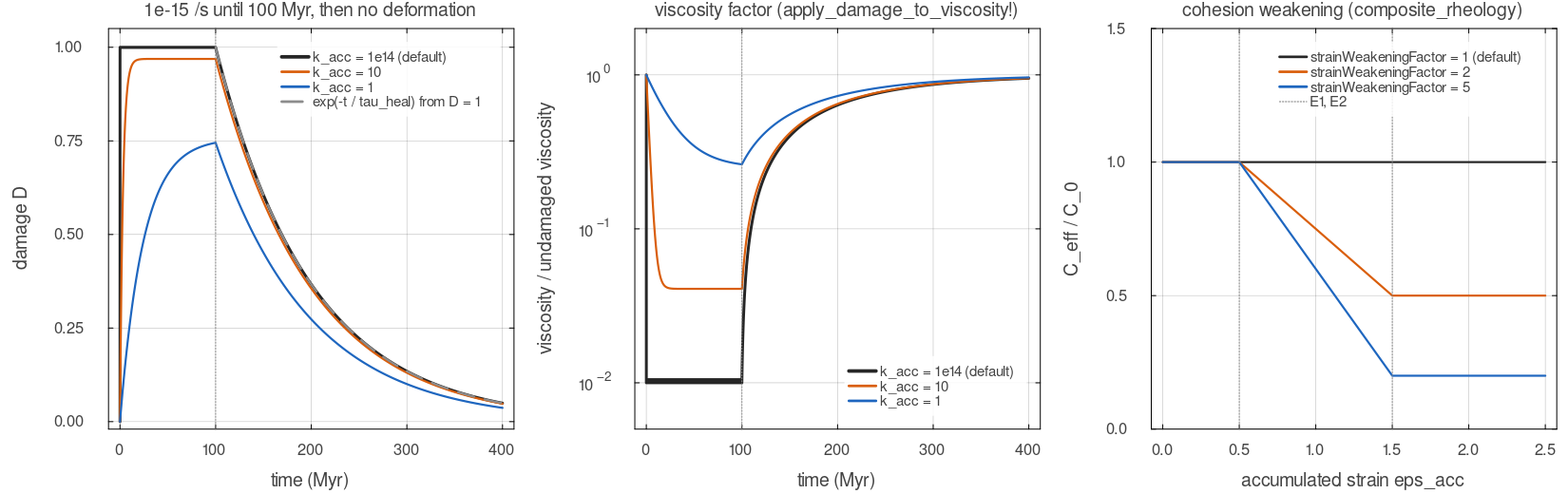
Left and middle: evolve_damage! and apply_damage_to_viscosity! on a single cell loaded at composite_rheology (creep and friction switched off, 10 km depth) against the accumulated strain, for three weakening factors.
Assumptions and simplifications
The two mechanisms are deliberately simple, and their simplifications are worth knowing when interpreting a run.
Grid damage is driven by strain rate, not by work. Damage theories derive the damage rate from the fraction of the deformational work that goes into creating new grain boundaries or voids (Bercovici & Ricard 2012). MILEVA uses the excess strain rate, with no dependence on stress, temperature or grain size. Grain-size reduction as a physical process is covered separately by the grain size model.
Healing is linear with one time constant. In rocks healing by grain growth is strongly temperature dependent, so hot regions heal faster than cold ones (Landuyt & Bercovici 2009).
is the same in every cell. Damage is Eulerian.
stays at its cell and is not advected, so a damaged zone that is carried away by the flow leaves its damage behind. This is a reasonable approximation where the deformation and the material stay together, as in a plate boundary fixed relative to the grid, and a poor one where damaged material travels far before it heals. The accumulated strain eps_acc, in contrast, lives on the markers and moves with the material.The strain-rate history lags by one step. Damage is evolved once per step from the strain rate of the previous solve, so it does not take part in the nonlinear iteration of the current step.
Strain weakening counts all strain and never heals.
eps_accsums the total strain, including viscous creep outside yielding regions, so material that has flowed far in the ductile mantle arrives at the surface already weakened. Brittle softening laws in lithosphere models usually count plastic strain only. Without healing a weakened marker stays weak for the rest of the run.
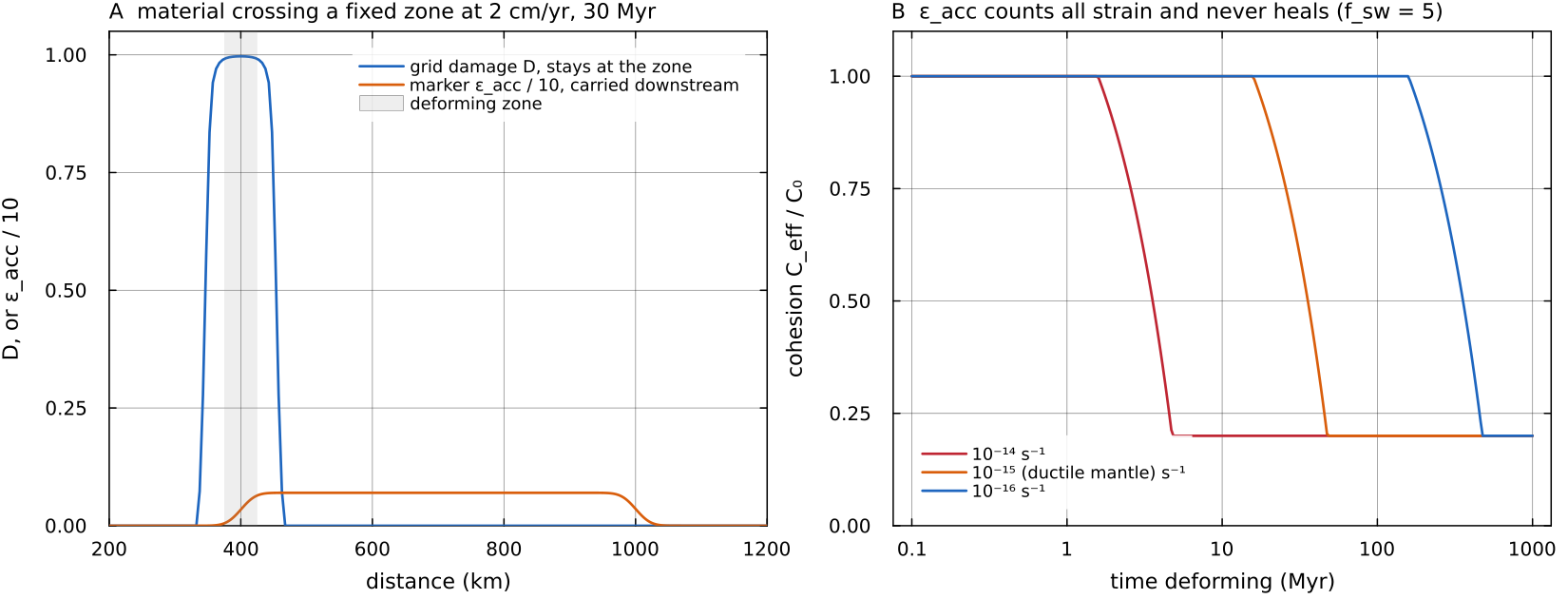
A: material moving at 2 cm/yr through a fixed 50 km zone for 30 Myr. The grid damage of evolve_damage! (composite_rheology for a marker deforming steadily, strainWeakeningFactor = 5. At the docs/scripts/fig_damage_sections.jl.
Scope
Both mechanisms are phenomenological. Their parameters are not calibrated against laboratory data, so results that depend on them should be presented together with a sensitivity test over
2-D and 3-D
evolve_damage! and apply_damage_to_viscosity! act element-wise on arrays of any dimension, and the marker strain accumulation and its projection have 2-D and 3-D methods. Both mechanisms behave identically in the annulus and on the Yin-Yang grid.
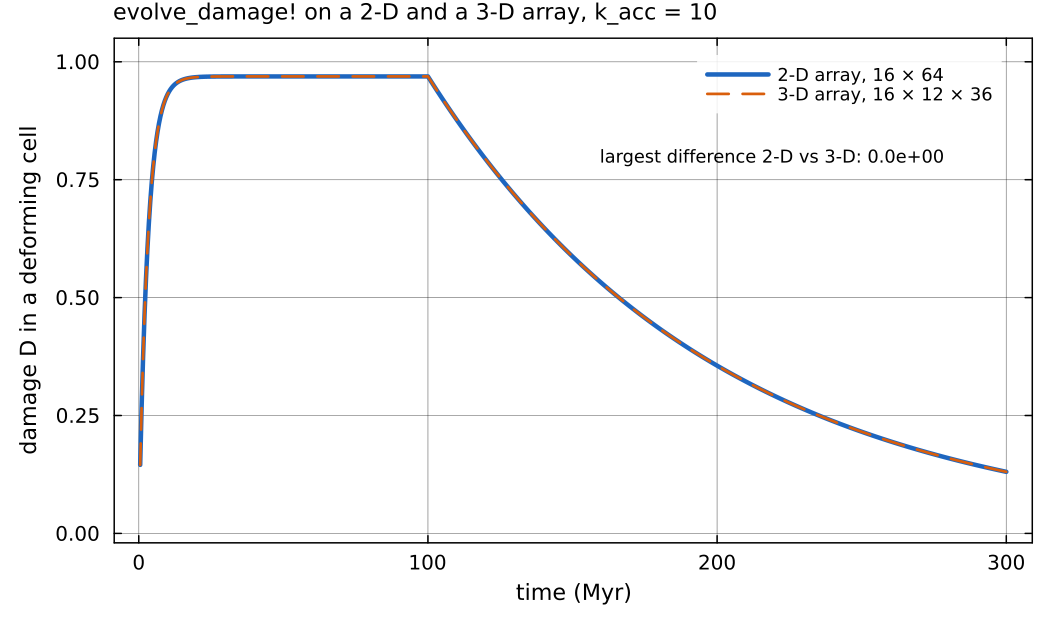
evolve_damage! on a 16 × 64 array and on a 16 × 12 × 36 array holding the same strain rates, docs/scripts/fig_damage_sections.jl.
Configuration
| field | default | meaning |
|---|---|---|
cfg.useDamage | false | evolve and apply grid damage |
cfg.damage_acc_rate | ||
cfg.damage_strain_rate_threshold | ||
cfg.damage_heal_time | ||
cfg.damage_max_weakening | 0.99 | |
cfg.useFullPlasticity | false | accumulate eps_acc on the markers and weaken the cohesion |
cfg.strainWeakeningFactor | 1 | |
cfg.strainWeakeningE1, cfg.strainWeakeningE2 | 0.5, 1.5 | onset and saturation strain |
mat.cohesion_upper, mat.cohesion_lower | 20, 60 MPa |
Where in the code
| What | File, function |
|---|---|
| damage evolution and viscosity factor | physics/damage.jl: evolve_damage!, apply_damage_to_viscosity! |
| damage in the time loop and the nonlinear sweeps | main_SphCon.jl, step 2 and the Picard loop |
| strain accumulation on markers | main_SphCon.jl, step 8: interp_grid_to_markers!(M, strainII .* dt, grid, :eps_acc, :add) |
projection of eps_acc | markers/markers_to_grid.jl: markers_to_grid |
| cohesion weakening | physics/composite_rheology.jl: composite_rheology, step 3 |
| checkpointing of | utils/save_checkpoint.jl, utils/load_checkpoint.jl |
Tests
tests/test_full_feature_smoke.jl: a short 2-D run with damage, eclogite kinetics and the other optional physics switched on stays finite.tests/test_config_timeloop.jl: a run with plastic yielding anduseFullPlasticitysurvives the time loop.tests/test_config_matrix.jl: damage and full plasticity are off by default.
Key references
Bercovici, D. & Ricard, Y. (2012). Mechanisms for the generation of plate tectonics by two-phase grain-damage and pinning. PEPI 202-203, 27-55.
Foley, B. J., Bercovici, D. & Landuyt, W. (2012). The conditions for plate tectonics on super-Earths: inferences from convection models with damage. EPSL 331-332, 281-290.
Lavier, L. L., Buck, W. R. & Poliakov, A. N. B. (2000). Factors controlling normal fault offset in an ideal brittle layer. JGR 105, 23431-23442.
Further reading
Bercovici, D., Ricard, Y. & Richards, M. A. (2000). The relation between mantle dynamics and plate tectonics: a primer. In The History and Dynamics of Global Plate Motions, AGU Geophysical Monograph 121, 5-46. doi:10.1029/GM121p0005
Bercovici, D. & Ricard, Y. (2014). Plate tectonics, damage and inheritance. Nature 508, 513-516. doi:10.1038/nature13072
Byerlee, J. (1978). Friction of rocks. Pure and Applied Geophysics 116, 615-626. doi:10.1007/BF00876528
Huismans, R. S. & Beaumont, C. (2003). Symmetric and asymmetric lithospheric extension: relative effects of frictional-plastic and viscous strain softening. JGR 108. doi:10.1029/2002JB002026
Landuyt, W. & Bercovici, D. (2009). Variations in planetary convection via the effect of climate on damage. EPSL 277, 29-37. doi:10.1016/j.epsl.2008.09.034
Montési, L. G. J. (2013). Fabric development as the key for forming ductile shear zones and enabling plate tectonics. Journal of Structural Geology 50, 254-266. doi:10.1016/j.jsg.2012.12.011
Moresi, L. & Solomatov, V. (1998). Mantle convection with a brittle lithosphere: thoughts on the global tectonic styles of the Earth and Venus. GJI 133, 669-682. doi:10.1046/j.1365-246x.1998.00521.x
Rozel, A., Ricard, Y. & Bercovici, D. (2011). A thermodynamically self-consistent damage equation for grain size evolution during dynamic recrystallization. GJI 184, 719-728. doi:10.1111/j.1365-246X.2010.04875.x
Schubert, G., Turcotte, D. L. & Olson, P. (2001). Mantle Convection in the Earth and Planets. Cambridge University Press. doi:10.1017/CBO9780511612879
Solomatov, V. S. & Moresi, L.-N. (1996). Stagnant lid convection on Venus. JGR Planets 101, 4737-4753. doi:10.1029/95JE03361
Tackley, P. J. (2000). Self-consistent generation of tectonic plates in time-dependent, three-dimensional mantle convection simulations. 2. Strain weakening and asthenosphere. G3 1. doi:10.1029/2000GC000043