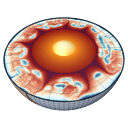
From mobile to stagnant lid: the viscosity contrast (2-D)
The same convecting shell run four times, changing only how much stiffer the cold top boundary layer is allowed to become. The viscosity follows an Arrhenius law,
with
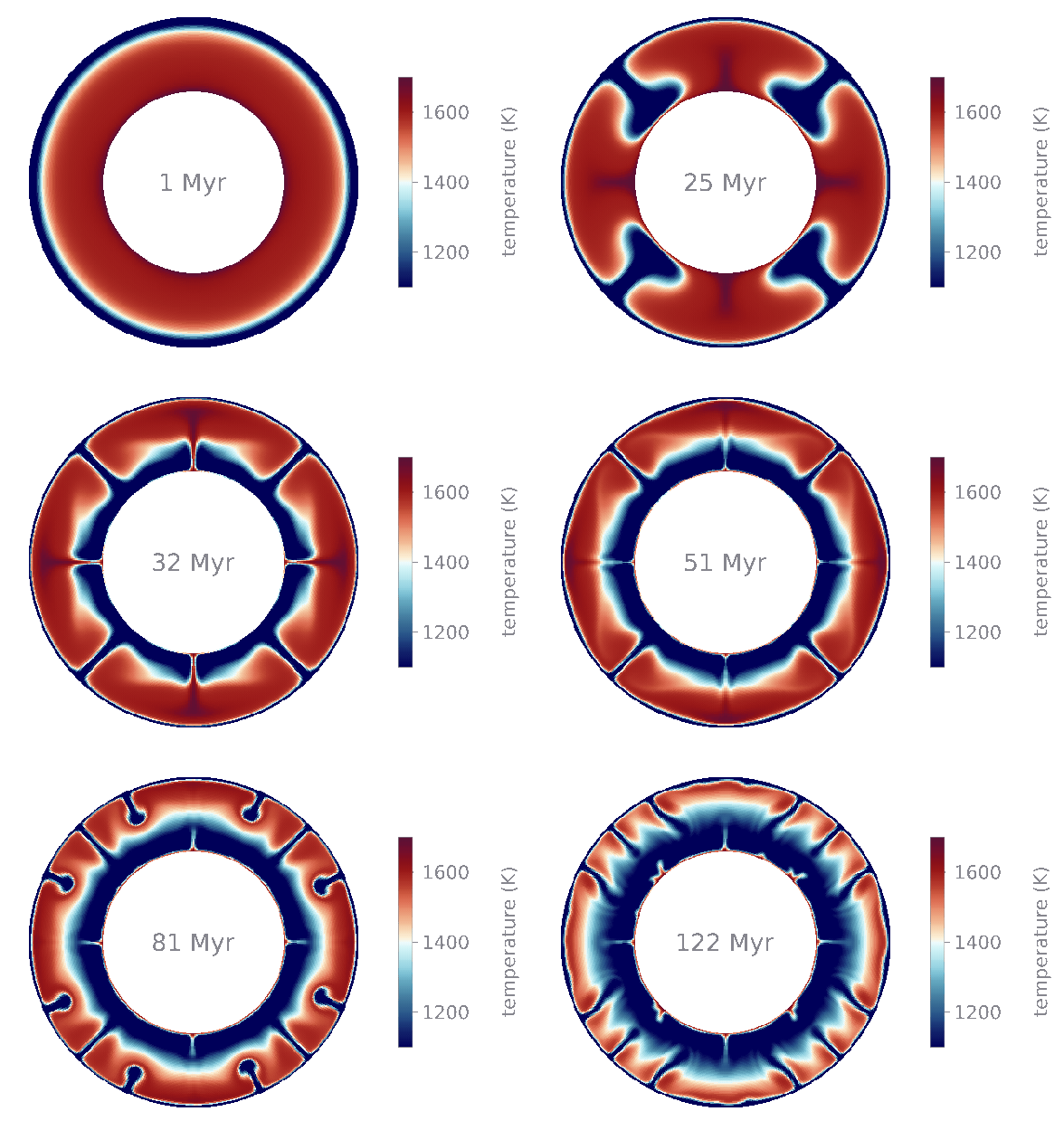
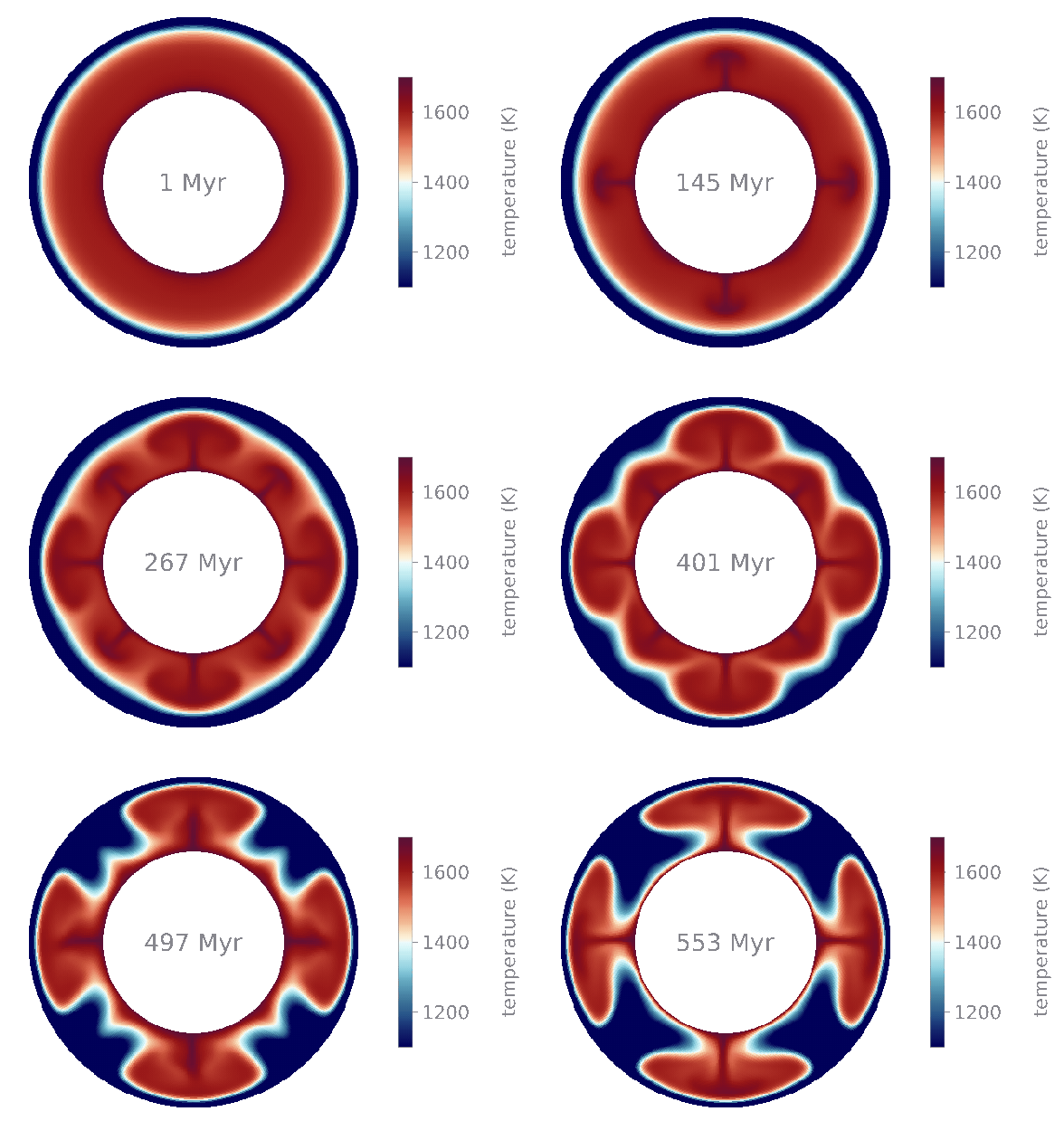
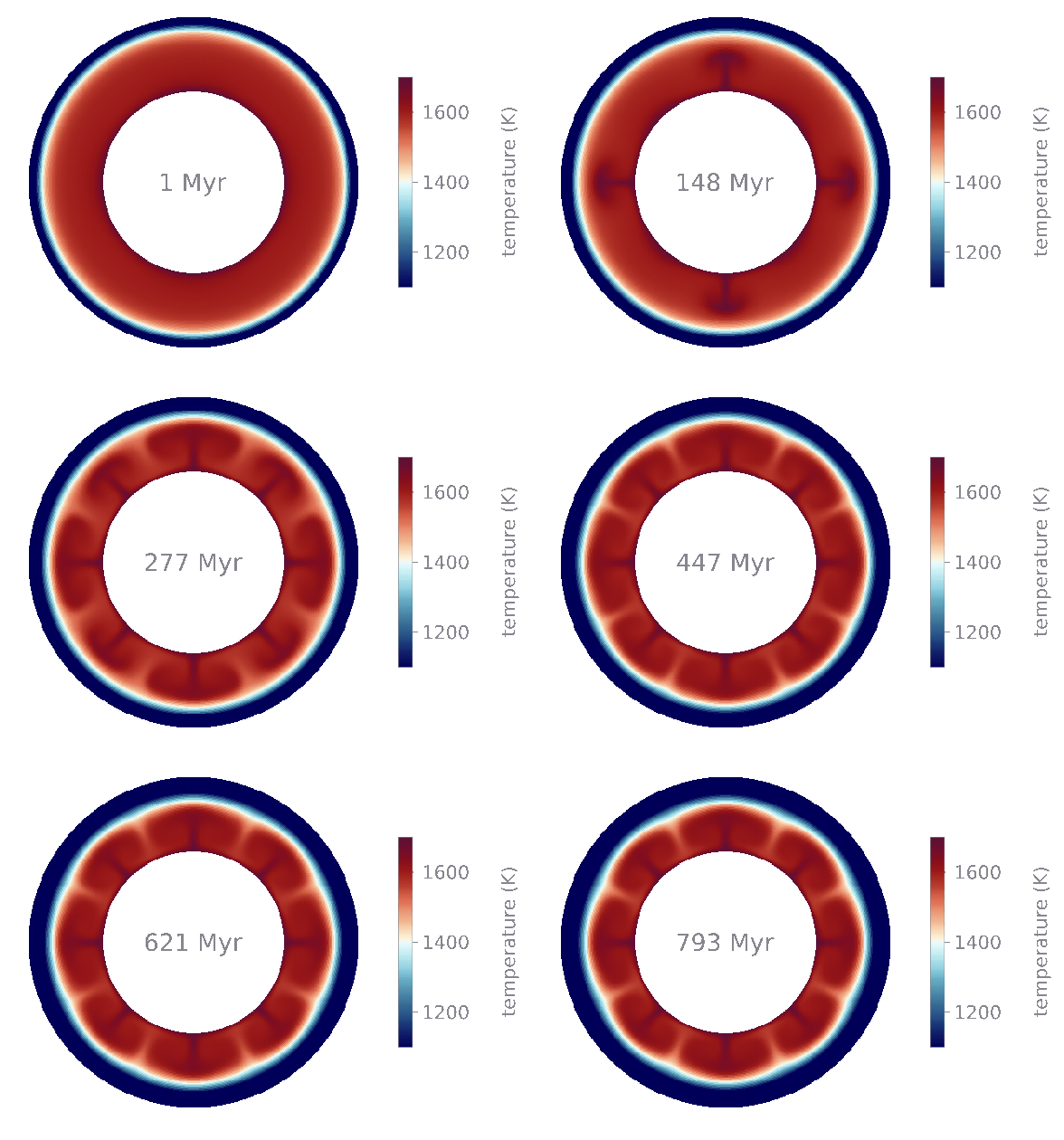
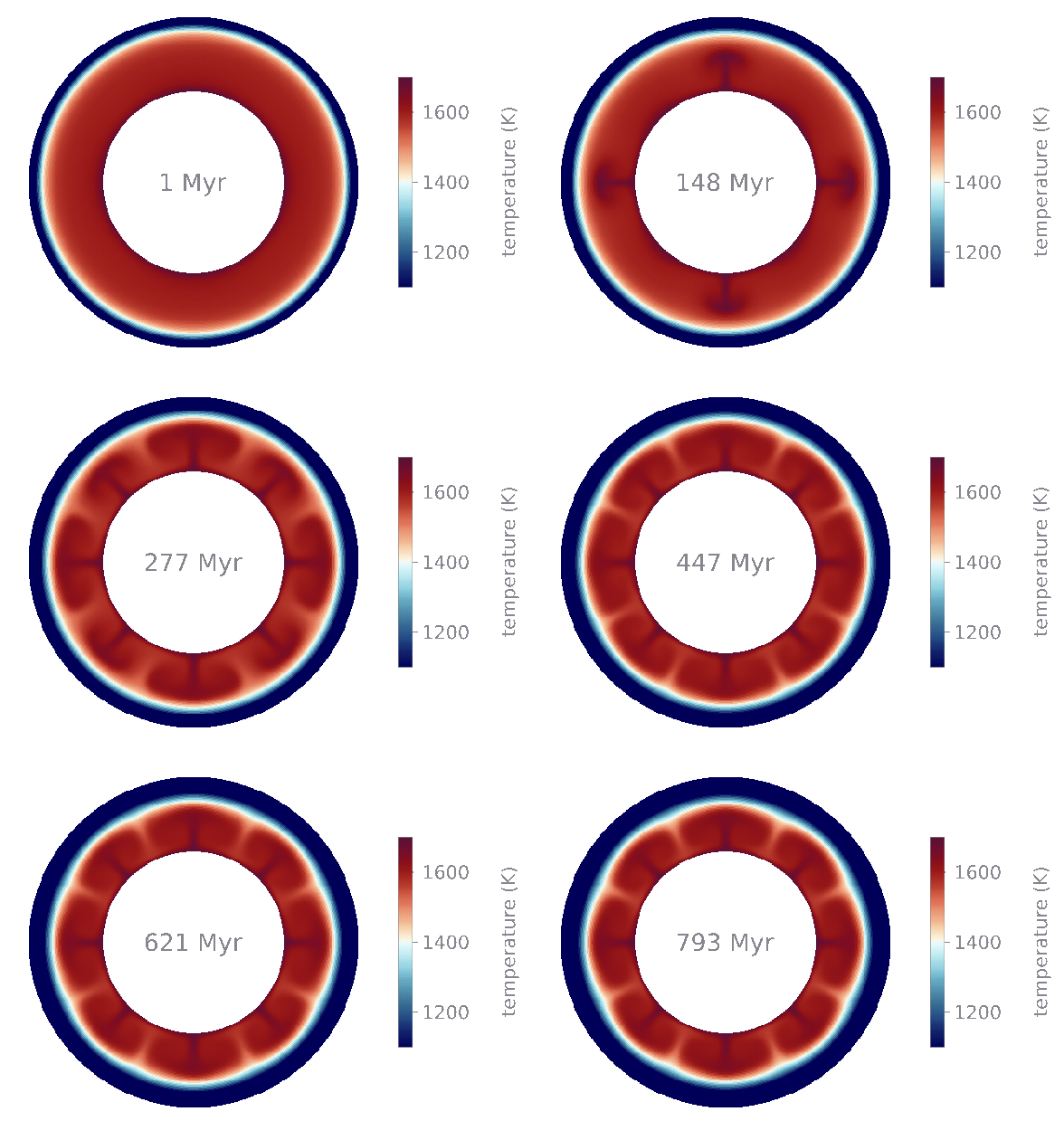
Temperature (1100 to 1700 K) of the four runs, interior Rayleigh number 10⁶ at
What changes
| lid mobility | cold lid (1300 K) | regime | ||
|---|---|---|---|---|
| 1 | 1.09 | 43 km | 45 | mobile: the surface moves with the mantle |
| 10² | 0.71 | 181 km | 12.8 | sluggish lid: the surface moves, more slowly |
| 10⁴ | 0.001 | 308 km | 4.7 | stagnant lid |
| 10⁶ | 0.000 | 308 km | 4.7 | stagnant lid |
Means over the last third of each run's diagnostics.csv. Lid mobility is the surface rms velocity over the whole-mantle rms velocity.
With a small contrast the cold boundary layer is barely stiffer than the interior. It takes part in the flow and sinks in cold sheets; the surface moves as fast as the mantle beneath it and heat leaves through a thin boundary layer (high Nusselt number). As the contrast grows, the coldest part of the layer stops deforming: it becomes a rigid lid that conducts heat but does not move, and convection continues underneath it in a softer interior that sees only the part of the temperature drop below the lid. The lid thickens, the surface stops moving and the heat flow falls. This is the transition from mobile-lid to stagnant-lid convection described by Solomatov (1995) and Moresi & Solomatov (1995).
Above about 10⁴ the lid is already rigid. Raising the contrast further only stiffens rock that does not move anyway, so the 10⁴ and 10⁶ runs give the same lid thickness, heat flow and interior temperature. What sets the behaviour of a one-plate planet is therefore not the exact lid viscosity but whether the lid can fail; a yield stress (see Rheology) is what lets a stiff lid break and move.
Running it
export GKSwstype=nul
for c in 1 1e2 1e4 1e6; do
  MILEVA_MAXSTEPS=1400 MILEVA_VTKEVERY=28 julia --project=. -t 2 \
      examples/annulus_stagnant_lid_2d.jl 1e6 64 $c 0 0
done
Arguments are the interior Rayleigh number, Nr, the contrast, the internal heating rate and the yield stress; the last two are 0 because these runs were made heated from below only and without yielding (the driver defaults add internal heating and an 8 MPa yield stress, see the stagnant-lid example). Each run took about 20 minutes on 2 threads. The animations were rendered with docs/scripts/render_annulus_gif.jl at a common temperature scale (clims=1100,1700).
References
Moresi, L.-N. & Solomatov, V. S. (1995), Numerical investigation of 2D convection with extremely large viscosity variations, Phys. Fluids 7, 2154-2162, doi:10.1063/1.868465. Solomatov, V. S. (1995), Scaling of temperature- and stress-dependent viscosity convection, Phys. Fluids 7, 266-274, doi:10.1063/1.868624.