Stokes + energy with markers-in-cell
Inf-sup stable Taylor–Hood (Q2/Q1) Stokes coupled to heat transport; RK4 marker advection carries composition, temperature, stress, plastic strain, grain size and porosity.
A thermomechanical finite-element framework for lithosphere and mantle dynamics, developed entirely in Julia on top of Gridap and named after Miletus, a historic center of early scientific thought.
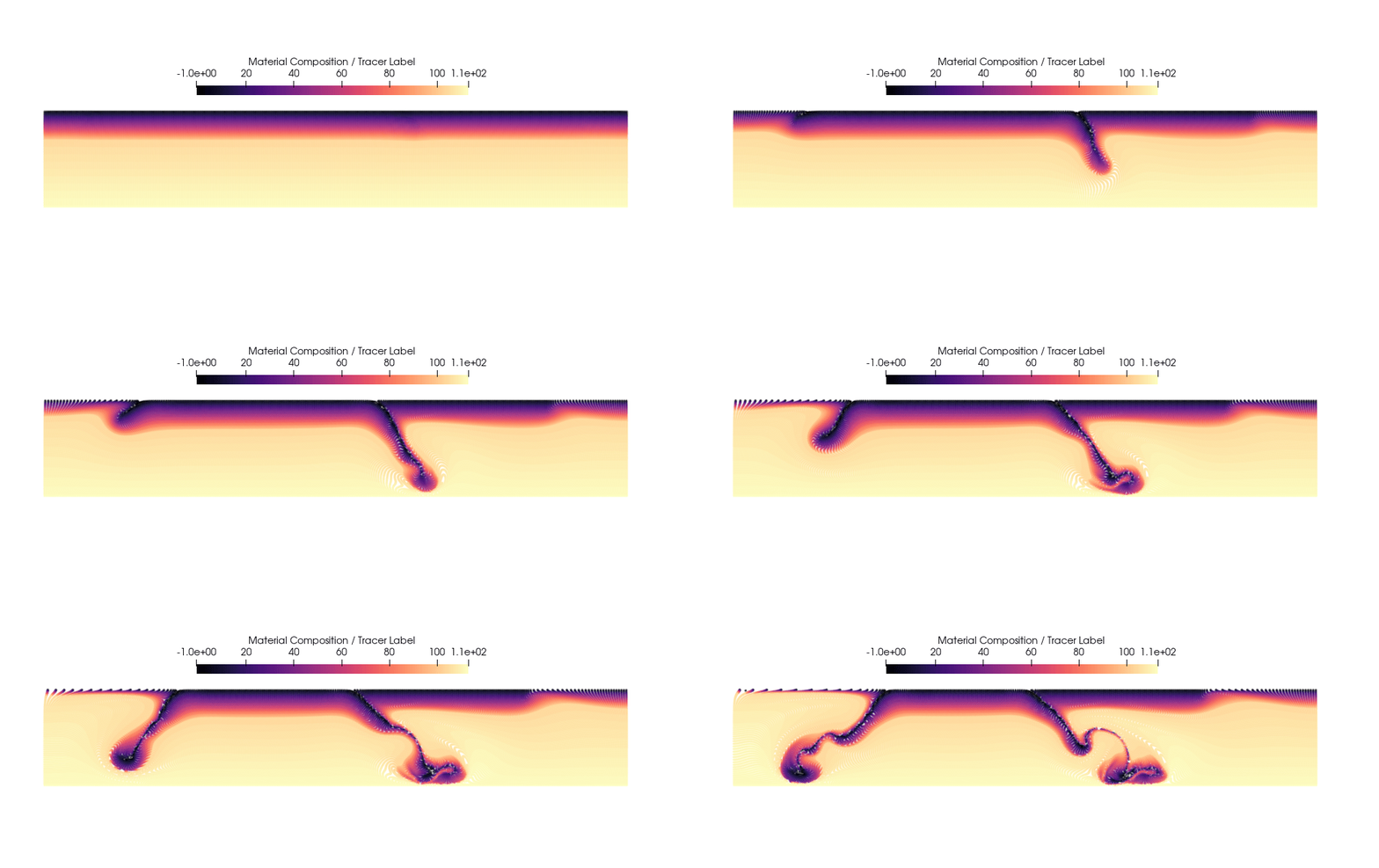
Modeling in Lithospheric Evolution Tectonics is a thermo-mechanical finite-element code for lithospheric and mantle dynamics. It solves the coupled Stokes and energy equations with a mixed, inf-sup stable Taylor–Hood discretisation (
MILET is a flat-include research code: main.jl includes the sources under src/ in dependency order and drives one simulation per run, fully specified by a single TOML parameter file (deep-merged onto cases/_defaults.toml).
Incompressible Boussinesq Stokes flow (anelastic ALA/TALA forms scaffolded), 2-D and 3-D Cartesian plus spherical-chunk geometry — Governing equations
Visco-elasto-plastic composite rheology with calibrated dislocation-creep flow laws (Ranalli 1995 catalogue), grain-size-sensitive diffusion creep, and Drucker–Prager yield — Rheology
Marker-in-cell transport: RK4 advection, reseeding, and subgrid-scale temperature diffusion after Gerya & Yuen (2003) — Markers
Divariant, rate-limited (Arrhenius) phase transitions with reaction-progress-dependent softening — Phase changes
Melting parameterisations and melt weakening — Melting
Heat transport with shear, adiabatic, and radiogenic heating, plus SUPG / entropy-viscosity stabilisation options — Heat transport
Sticky-air free surface with FSSA stabilisation and an ALE surface-tracking option — Free surface
Direct (MUMPS) and iterative (GMG, PETSc) solvers with cached factorisations and warm starts — Linear solvers
Picard and Newton nonlinear loops, CFL-limited time stepping, checkpoint/restart, VTK output — Time stepping
Adaptive mesh refinement and ALE — AMR & ALE
Geometric multigrid 3-D Stokes solver — Geometric multigrid. Right-preconditioned FGMRES on the monolithic saddle-point system; the velocity block is preconditioned by V-cycles of a Galerkin geometric multigrid ([solver] type = "gmg" (gmg_levels, gmg_cheb_degree, gmg_cycles, gmg_coarse_dofs); shipped 3-D cases: cases/plume3d_cube_gmg.toml, cases/plume3d_slab_gmg.toml. Implementation: src/solvers/GMG.jl, src/solvers/BlockMG.jl.
Two-phase (McKenzie) flow — Two-phase flow. Porous melt migration through a compacting viscous matrix, as a 3-field extension of the Stokes solve (Katz 2008; Rhebergen, Wells & Katz 2014):
discretised as [twophase] do_two_phase = true (k0, phi0, n_perm, mu_fluid, rho_fluid, alpha_phi, phi_min, pf_surface0, …). Implementation: src/physics/TwoPhase.jl.
Grain-size evolution (paleowattmeter) — Grain-size evolution. Per-marker grain size
integrated with exact operator-split sub-flows (update_grain_size, src/materials/GrainSize.jl) and two-way coupled to the composite diffusion + dislocation rheology. Per-rock keys grain_G0, grain_p, grain_Eg, grain_Vg, grain_lambda, grain_gamma, grain_c, grain_init (grain_G0 = 0 freezes the grain size).
Strain softening & healing — Softening & healing. Linear cohesion/friction weakening over [strain_thresh_init, strain_thresh_weak], now with plastic-strain gating ([rheology] strain_gate_plastic = true: weakening strain accumulates only where the cell actually yields), temperature-dependent Arrhenius healing (heal_tau0, heal_E, heal_Tref), optional viscous strain softening (visc_soft_factor), and a configurable yield-stress cap (yield_stress_max).
# install dependencies (once)
julia --project=. -e 'using Pkg; Pkg.instantiate()'

# verification benchmark: SolCx (variable-viscosity Stokes, analytic solution)
julia --project=. main.jl cases/solcx_fixed.toml

# convection benchmark: Blankenbach case 1a
julia --project=. main.jl cases/blankenbach_1a.toml

# a worked geodynamic example: thermo-mechanical subduction
julia --project=. main.jl cases/subduction.toml

# 3-D plume with the geometric-multigrid solver
julia -t auto --project=. main.jl cases/plume3d_cube_gmg.toml
Results are written as VTK files (solution fields, markers, topography) to output/<case>/, viewable in ParaView — see Getting started for output formats and the depth-positive-down camera setup. Every TOML key is documented in the parameter-file reference.
SolCx (Duretz et al. 2011): grid convergence of the variable-viscosity Stokes solution (cases/solcx_fixed_n*.toml)
Blankenbach et al. (1989) case 1a: steady convection diagnostics (cases/blankenbach_*.toml)
Smoke and benchmark tests under test/ (julia --project=. test/runtests.jl) — see Benchmarks and Testing
The multi-species volatile transport module is part of a separate study in preparation and is not included in this release; shipped cases run with volatiles disabled.
3-D and spherical-chunk support are functional but less exercised than the 2-D Cartesian path.
A methods paper describing MILET and its application to eclogite-driven lithospheric foundering on Venus is under review at Earth and Planetary Science Letters. Until it is published, please cite the repository: github.com/okaragoz/MILET.